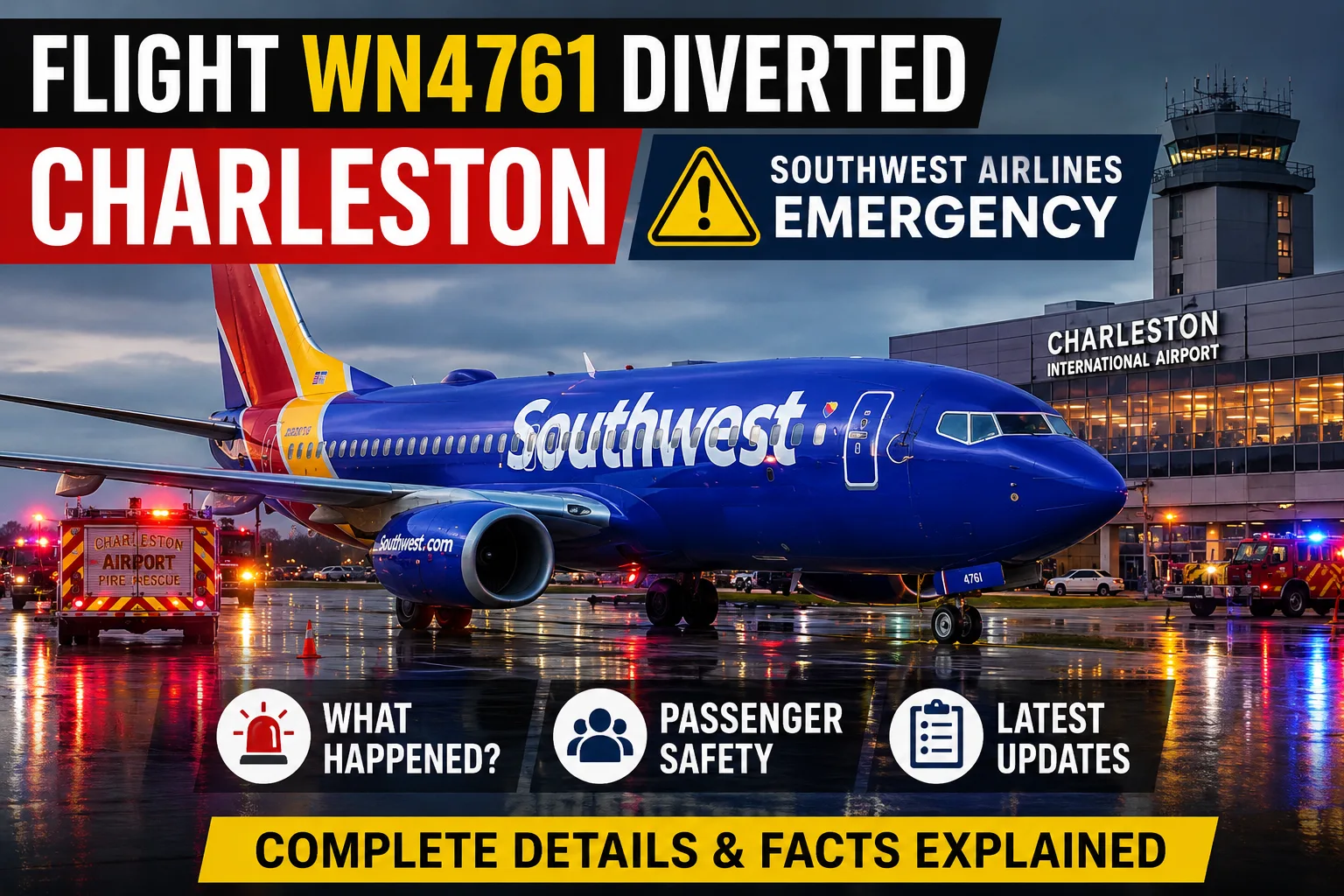
Flight WN4761 Diverted Charleston: Everything You Need to Know About the Southwest Airlines Emergency
Flight WN4761 diverted Charleston on July 20, 2026, after the crew of a Southwest Airlines Boeing 737-800 reported a suspected fuel leak while cruising at 37,000 feet over South Carolina. The incident prompted an airborne emergency declaration, a priority landing at Charleston International Airport, and a significant delay for passengers who had originally boarded in Orlando headed for Manchester, New Hampshire. This article breaks down every confirmed detail of what happened, explains the aviation safety protocols that guided the crew’s response, and gives passengers and aviation observers a complete picture of the event from takeoff to the moment the replacement aircraft finally touched down in Manchester.
Flight WN4761 Diverted Charleston: The Full Story of the July 20 Emergency
Southwest Airlines Flight WN4761 is a regularly scheduled domestic service operating from Orlando International Airport (MCO) in Florida to Manchester-Boston Regional Airport (MHT) in New Hampshire. On the morning of Monday, July 20, 2026, the aircraft — a Boeing 737-800 registered as N8662F, approximately 11 years old — pushed back from Orlando’s Terminal A, Gate 125, and departed at 8:54 AM Eastern Daylight Time.
For roughly the first hour of the flight, everything proceeded normally. Passengers settled in, the crew completed standard in-flight service routines, and the aircraft climbed to its cruising altitude of 37,000 feet over the southeastern United States. There was no indication at that point that the flight would become anything other than a routine two-hour trip up the East Coast.
That changed when the flight deck crew observed instrument readings that suggested a potential fuel leak. Fuel anomalies in flight are treated with the highest level of urgency in commercial aviation. Unlike many other mechanical issues, an uncontrolled fuel leak poses a direct and immediate risk to continued safe flight and landing, as fuel feeds the engines and any significant loss of it can threaten the aircraft’s ability to maintain altitude, speed, and ultimately reach a runway safely.
The pilots of WN4761 made an immediate decision to declare an airborne emergency. They transmitted a “squawk 7700” transponder code — the universal aviation emergency signal — which instantly alerts every radar facility monitoring the aircraft and gives it priority handling across the national airspace system. Air traffic controllers immediately cleared the flight for an expedited descent and vector to the nearest suitable airport: Charleston International Airport (CHS) in South Carolina, located approximately 60 miles northwest of Charleston’s coastline.
Emergency response teams at Charleston International were notified immediately. Fire trucks, rescue vehicles, and airport emergency personnel were positioned along the runway well before the aircraft touched down. The pilots executed what was described as a safe, uneventful landing on Runway 15 at CHS. Not a single passenger or crew member reported an injury.
What Caused the Fuel Leak Indication on Flight WN4761?
At the time of writing, Southwest Airlines has not issued a detailed public statement identifying the precise mechanical cause of the fuel leak indication that led to the flight WN4761 diverted Charleston event. What is confirmed is that the flight crew observed instrument readings consistent with a suspected fuel leak and acted immediately in line with standard operating procedures.
Aircraft fuel systems are highly complex. A Boeing 737-800 carries fuel in two main wing tanks and a center tank. Fuel quantity, flow, and pressure are continuously monitored by multiple independent systems in the cockpit. When a discrepancy appears between expected and actual fuel readings, or when sensors detect fuel presence where it should not be, it registers as a warning that demands immediate pilot attention.
The specific Boeing 737-800 involved — registration N8662F — remained in Charleston after the incident, where Southwest Airlines maintenance teams began a comprehensive inspection to determine the root cause of the indication. Until that investigation is complete and the aircraft is cleared by certified maintenance personnel, it will remain grounded in Charleston.
Whether the original indication reflected an actual physical fuel leak, a sensor malfunction, or a related systems anomaly, the crew’s decision to take it seriously and declare an emergency was entirely correct and consistent with best practices in commercial aviation safety. In aviation, an abundance of caution in the face of potential fuel issues is never a mistake.
Squawk 7700: Understanding the Emergency Signal That Guided the Diversion
One of the most important details in the flight WN4761 diverted Charleston story is the crew’s decision to transmit a squawk 7700 transponder code. For readers unfamiliar with aviation terminology, understanding what this signal means and what happens when it is transmitted gives important context to how the situation was handled.
Every commercial aircraft continuously transmits a transponder code that allows air traffic control radar to identify the specific aircraft on their screens. Most flights operate on assigned four-digit codes that identify their route and altitude. However, three codes are universally reserved for emergency situations:
Squawk 7700 — General emergency. When a crew selects this code, every radar facility receiving the aircraft’s transponder signal is automatically alerted that the flight is experiencing an emergency requiring priority handling. The aircraft immediately becomes the highest priority in the surrounding airspace.
Squawk 7600 — Radio communications failure. This code tells controllers that the aircraft has lost radio contact.
Squawk 7500 — Unlawful interference (hijacking). This code silently alerts authorities to a security emergency.
When the WN4761 crew squawked 7700, air traffic controllers across the southeastern United States knew instantly that the flight was in distress. Controllers cleared other traffic from the descent path, coordinated with Charleston International Airport to have emergency services standing by, and gave the WN4761 crew direct routing to minimize time in the air. This seamless coordination between the flight deck and the ground-based air traffic system is exactly how the aviation safety network is designed to work, and in this case it functioned precisely as intended.
Flight WN4761 Diverted Charleston: The Passenger Experience and Airline Response
For passengers aboard WN4761, the diversion to Charleston International represented an unexpected and stressful interruption to their travel plans. The aircraft landed safely in Charleston, emergency vehicles conducted their standard checks, and passengers were eventually deplaned while Southwest Airlines personnel coordinated the airline’s response.
Southwest moved quickly to address the situation. The airline arranged a replacement aircraft — a newer Boeing 737 MAX 8 registered as N8881L — to travel to Charleston and pick up the stranded passengers. The 737 MAX 8 is Boeing’s current-generation narrow-body aircraft, incorporating updated CFM LEAP-1B engines, improved aerodynamics, and a range of technological enhancements over the older 737-800 it replaced.
After a total ground delay of approximately four hours in Charleston, the passengers re-boarded the replacement aircraft and continued their journey to Manchester-Boston Regional Airport. The flight ultimately arrived at its final destination roughly five hours behind the original schedule.
For passengers who had connecting flights, accommodation reservations, or other time-sensitive commitments in Manchester or the broader New England area, a five-hour delay represented a genuine disruption. Southwest Airlines’ standard policies in the case of flight diversions caused by mechanical issues or safety-related emergencies typically include rebooking assistance for missed connections, reimbursement for reasonable expenses incurred during extended delays, and in some cases travel credits.
Passengers who experienced significant disruption due to the flight WN4761 diverted Charleston event are advised to contact Southwest Airlines directly through their official website at southwest.com to understand their options under the airline’s Customer Service Commitment and any applicable delay compensation policies.
The Boeing 737-800: Understanding the Aircraft at the Center of the Incident
The aircraft initially operating Southwest Flight WN4761 was a Boeing 737-800 (registration N8662F), an 11-year-old narrow-body jet that is one of the most common commercial aircraft in service worldwide. Understanding this aircraft type helps put the incident in broader context.
The Boeing 737-800 is part of the 737 Next Generation (737NG) family, which entered service in the 1990s and became the backbone of short- to medium-haul operations at airlines around the globe. Southwest Airlines operates one of the world’s largest fleets of Boeing 737s and has standardized on the type for virtually its entire route network, giving its maintenance teams deep expertise in the aircraft.
The 737-800 is powered by CFM56-7B engines and typically seats between 162 and 189 passengers in a single-class configuration. It has an exceptional safety record over its decades of service, with the fuel system designed to highly rigorous standards. Fuel systems on Boeing 737s include multiple redundancies — separate pumps for each tank, fuel quantity indicators with independent backup sensors, and multiple warning systems to alert the crew of any anomaly.
The age of the specific aircraft involved (approximately 11 years) is well within normal operational parameters. Commercial aircraft are routinely operated for 20 to 30 years with appropriate maintenance, and age alone is not a significant risk factor when maintenance schedules are properly followed. The investigation by Southwest maintenance teams will focus on the specific component or system that generated the fuel leak indication, which will then determine whether the aircraft requires a targeted repair, parts replacement, or other intervention before it returns to service.
Charleston International Airport: The Diversion Airport That Handled the Emergency
Charleston International Airport (IATA: CHS, ICAO: KCHS) is a joint civil-military airport serving the Charleston, South Carolina metropolitan area. It is also home to Joint Base Charleston (JB CHS), a major United States Air Force installation. The dual civilian-military nature of the facility means that Charleston International maintains emergency response capabilities that exceed those of many similarly sized civilian airports.
The airport is served by multiple major and regional carriers and handles significant cargo traffic in addition to passenger operations. Its location in coastal South Carolina places it ideally positioned as a diversion point for aircraft experiencing issues along the busy East Coast air corridor — the flight path connecting Florida and the southeastern states with the northeastern United States, one of the most heavily traveled routes in North American aviation.
The Runway 15 used by WN4761 for its emergency landing is one of the airport’s primary runways, capable of accommodating wide-body aircraft. Its length and surface condition posed no challenge for the Boeing 737-800, which requires significantly less runway than larger jets.
The professionalism and preparedness of the Charleston International emergency response team in meeting the aircraft with fire and rescue equipment ready was a critical element in the safe outcome of the flight WN4761 diverted Charleston incident. Airport emergency planning — including coordinated drills and established protocols for receiving declared emergencies — ensures that a response of this kind can be executed within minutes of notification.
For more information about Charleston International Airport, including current flight information and services, visit the official airport website at chs.com.
How Airlines Handle Flight Diversions: Behind the Scenes of an Emergency Response
The flight WN4761 diverted Charleston event provides a useful window into the complex behind-the-scenes operations that take place whenever a commercial airline declares an emergency and diverts to an unplanned airport. Most passengers experience only the visible portion of the airline’s response — the ground delay, the communication from crew, and eventually the replacement aircraft or rebooking. But the operational machinery that runs in the background is extensive.
When a Southwest flight declares an emergency, the airline’s System Operations Control Center (SOCC) — a 24-hour operations hub that monitors all active Southwest flights — is immediately notified. The SOCC coordinates the operational response in real time, working simultaneously on several fronts.
First, they establish contact with the diversion airport to arrange gate access, ground handling services, fuel, and catering for the aircraft. Second, they begin sourcing a replacement aircraft from the network — identifying which aircraft in the fleet is closest, has the necessary availability, and can be repositioned to the diversion airport without cascading disruptions across the rest of the schedule. Third, they notify crew scheduling to ensure that the replacement aircraft has a qualified and legal crew, accounting for duty time regulations that govern how many consecutive hours pilots and flight attendants may work.
At the same time, airport customer service agents at the diversion location — in this case, Charleston — are contacted and asked to assist the stranded passengers with information, refreshments, and rebooking assistance. Because Charleston is not a Southwest hub, staffing resources there may be limited, which can affect the quality of on-the-ground passenger support.
Southwest Airlines operates on an open seating model with no assigned seats, which simplifies the process of moving passengers onto a replacement aircraft. All passengers who boarded in Orlando simply reboard the new plane, and the flight continues to the original destination without the need to manage complex seat reassignment logistics.
The entire operation — from the moment of the emergency declaration to the moment the replacement aircraft wheels up from Charleston — took approximately four hours in the case of WN4761, which is a reasonable timeline given the complexity of the required coordination.
Flight WN4761 Diverted Charleston: What Passengers Need to Know About Their Rights
If you were a passenger on the flight that was diverted — or if you are a frequent traveler seeking to understand what protections apply in similar situations — it is worth understanding the framework of passenger rights that applies to events like the flight WN4761 diverted Charleston incident.
In the United States, the Department of Transportation (DOT) regulates airline passenger rights. For domestic flights, the DOT’s current rules primarily mandate compensation for significant delays related to situations within the airline’s control (such as overselling or scheduling errors). Mechanical issues occupy a complex middle ground — they are generally classified as within the airline’s control for compensation purposes under some circumstances, though each case can differ.
Southwest Airlines’ own Customer Service Commitment, available on its website, outlines what the airline provides in various delay and disruption scenarios. For extended delays caused by mechanical issues, Southwest has historically offered travel credits as a goodwill gesture, even in situations where it is not strictly required to do so by regulation.
Passengers should also be aware that travel insurance policies — particularly those with trip interruption and travel delay coverage — can provide reimbursement for out-of-pocket expenses such as hotel accommodation, meals, and transportation incurred during an extended diversion delay. Travelers who purchased insurance for their trip should review their policy documents or contact their insurer promptly.
For the most current information on U.S. airline passenger rights, the Department of Transportation’s Aviation Consumer Protection website (transportation.gov/airconsumer) is the authoritative and regularly updated resource.
Aviation Safety and Fuel-Related Incidents: Broader Context for the WN4761 Event
The flight WN4761 diverted Charleston incident, while alarming in the moment for those on board, belongs to a category of aviation events that the industry’s safety systems are specifically designed to handle. Fuel-related anomalies in commercial aviation encompass a wide range of situations — from actual physical leaks to sensor malfunctions, from fuel exhaustion events to contamination issues — and each is taken with the utmost seriousness.
Aviation safety authorities including the Federal Aviation Administration (FAA) and the National Transportation Safety Board (NTSB) collect and analyze data on all significant aviation incidents, including fuel-related issues. This data informs ongoing updates to maintenance requirements, pilot training protocols, and aircraft design standards.
The FAA maintains an extensive database of aviation safety data through its Aviation Safety Hotline and its public Aviation Safety Information Analysis and Sharing (ASIAS) program. These systems allow the aviation community to identify emerging patterns and implement preventive measures before isolated incidents become systemic problems.
It is worth noting that the aviation safety system worked exactly as intended in the WN4761 event. The flight crew identified the anomaly, made the correct decision to prioritize safety over schedule, declared an emergency through proper channels, and executed a controlled diversion to a suitable airport. No injuries occurred. The aircraft was safely secured for inspection. Passengers were inconvenienced but ultimately reached their destination. This outcome is the product of decades of safety culture development, rigorous crew training, and well-designed protocols.
For anyone interested in aviation safety data and incident reports, the NTSB’s public database of aviation accident and incident data is accessible at ntsb.gov/aviation.
Tracking Future Flights: Tools for Monitoring WN4761 and Other Southwest Services
For passengers booked on future WN4761 flights, or for aviation enthusiasts interested in monitoring the status of Southwest Airlines services, several reliable flight tracking platforms provide real-time data.
FlightAware (flightaware.com) is one of the most comprehensive flight tracking services available, offering real-time position data, delay and cancellation information, historical flight records, and airport status updates. Users can search specifically for Southwest Airlines WN4761 to see current and upcoming scheduled flights, as well as historical data on the route’s on-time performance.
FlightStats (flightstats.com) provides similar real-time tracking capabilities along with detailed on-time performance statistics that help travelers understand the historical reliability of specific flight numbers.
FlightRadar24 (flightradar24.com) is particularly popular among aviation enthusiasts for its detailed map-based interface that allows users to track individual aircraft positions in real time across the globe. The platform also maintains historical flight data, including records of the WN4761 diversion on July 20, 2026.
Southwest Airlines itself provides flight status information through its official website at southwest.com, including real-time updates on delays, diversions, and gate changes for passengers who are actively traveling.
Flight WN4761 Diverted Charleston: Key Takeaways and Final Summary
The flight WN4761 diverted Charleston event of July 20, 2026, is a clear example of the aviation safety system functioning at its best. A Southwest Airlines Boeing 737-800 crew identified a suspected fuel leak at cruising altitude, made an immediate and correct decision to declare an emergency, and executed a safe diversion to Charleston International Airport with zero injuries among passengers or crew.
The following key facts summarize the incident:
Flight number and airline: Southwest Airlines WN4761 Route: Orlando International Airport (MCO) to Manchester-Boston Regional Airport (MHT) Departure: 8:54 AM EDT, Orlando Terminal A, Gate 125 Issue reported: Suspected fuel leak at 37,000 feet altitude over South Carolina Emergency type: Squawk 7700 airborne emergency declaration Diversion airport: Charleston International Airport (CHS), South Carolina, Runway 15 Original aircraft: Boeing 737-800, registration N8662F (approximately 11 years old) Injuries: None Replacement aircraft: Boeing 737 MAX 8, registration N8881L Ground delay in Charleston: Approximately four hours Total delay to final destination: Approximately five hours Aircraft status after incident: Retained in Charleston for thorough maintenance inspection
The bigger picture the incident illustrates is the importance of well-trained crews, robust emergency protocols, coordinated air traffic management, and prepared airport emergency teams working together. Each element of that system performed its role, and the result was that everyone arrived safely — just considerably later than originally planned.
Passengers and aviation observers seeking ongoing updates on the investigation, the status of the grounded aircraft, or Southwest Airlines’ response can monitor the airline’s official communications at southwest.com and the aviation news network AIRLIVE at airlive.net, which broke the story with detailed reporting on July 20, 2026.
External resources referenced in this article: Southwest Airlines official site — southwest.com | Charleston International Airport — chs.com | FlightAware flight tracking — flightaware.com | FlightRadar24 — flightradar24.com | NTSB aviation safety database — ntsb.gov/aviation | DOT Aviation Consumer Protection — transportation.gov/airconsumer | AIRLIVE aviation news — airlive.net