Days Ago Calculator
90 Days From Today Past: The Ultimate Date Calculation Guide
Have you ever found yourself staring at a calendar, trying to calculate timelines for a crucial project, looking up transactional history, or figuring out the exact date a legal grace period began? If you have ever typed 90 days from today past into a search engine, you are not alone.
Time tracking is an essential part of our daily personal and professional lives. Knowing how to quickly look back exactly 90 days from the current date is incredibly useful for federal compliance, financial auditing, project retrospectives, and health tracking.
This comprehensive guide breaks down everything you need to know about calculating 90 days from today past, why this specific time frame matters so much in the United States, how to compute it manually or programmatically, and how to use our dedicated tool to get instantaneous results.
Date & Age Tracker: Kisi bhi specific date ya saal ka accurate gap aur total time span instantly calculate karein.
Years Ago Calculator Try KareinWhat Exactly is 90 Days From Today Past?
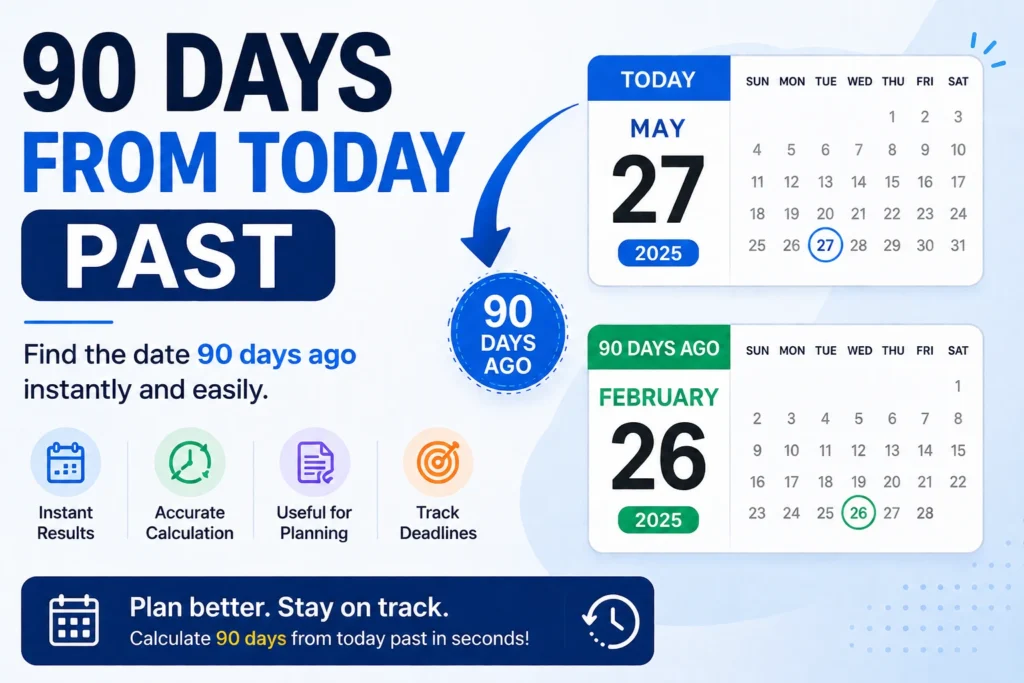
When we look at 90 days from today past, we are essentially looking back one fiscal quarter or approximately three calendar months into the past. Because months vary in length (28, 29, 30, or 31 days), simply counting three months backward on your fingers will often land you on the wrong date.
To find the true historical date that occurred exactly 90 days ago, you must count every individual calendar day backward from today’s date. This precise figure is standard across many institutional frameworks in the US, which is why manual errors can sometimes result in costly professional mistakes.
Why Do We Measure 90-Day Cycles?
Human psychology and institutional structures are deeply tied to 90-day intervals. In business, a 90-day period represents a quarter—a fundamental unit used to measure performance, ship software updates, and file mandatory tax documentation. In personal development, a 90-day window is widely recognized as the optimal time frame to build sustainable habits or undergo lifestyle transformations without feeling overwhelmed by long-term commitments.
Why the "90 Days From Today Past" Timeline Matters in the US
The concept of 90 days from today past holds significant legal, financial, and personal weight for American readers. Various industries depend on this exact window to enforce deadlines and analyze retrospective data.
1. Corporate and Financial Quarterly Reviews
In corporate America, time is divided into business quarters (Q1, Q2, Q3, and Q4). When executives and analysts look at a company’s performance, they regularly examine data from 90 days from today past to determine growth trajectory, burn rate, and revenue metrics.
Furthermore, the U.S. Securities and Exchange Commission (SEC) requires publicly traded companies to file Form 10-Q quarterly reports. Calculating exactly when your data capture period ends is critical to avoiding compliance penalties.
2. Legal Regulations and Lookback Periods
In legal and bankruptcy proceedings, lookback periods are critical. For example, if an individual or corporation files for bankruptcy, the courts look back at transactions made 90 days from today past to ensure that no preferential transfers or hidden assets were shifted to specific creditors or family members right before filing.
3. Healthcare and Medical Prescriptions
Insurance companies and health providers in the United States frequently use 90-day cycles for maintenance medication. If you have a mail-order pharmacy prescription plan through providers like CVS Caremark or Express Scripts, your refills operate on a strict quarterly schedule. Understanding your timeline ensures you never run out of critical healthcare supplies.
4. Employment Probationary Frameworks
When starting a new job in the United States, employers commonly enforce a 90-day introductory or probationary period. During this window, managers evaluate cultural fit, execution speed, and attendance records. Employees use our calculation tools to trace their steps back to their original start date to find out precisely when their corporate benefits, health insurance matching, or 401(k) vesting rights kick in.
How to Calculate 90 Days From Today Past Manually
If you do not have a digital tool on hand, you can compute 90 days from today past using simple arithmetic and a calendar.
To perform this manually, you need to know the exact number of days in each preceding month. Let’s look at the standard blueprint for tracking backward:
The Monthly Day Count Matrix
Before counting, remember the standard days assigned to each month:
31 days: January, March, May, July, August, October, December
30 days: April, June, September, November
28/29 days: February (depending on Leap Year status)
Step-by-Step Manual Calculation Example
Let’s assume today’s date is July 5, 2026, and we want to find out the date 90 days from today past.
Current Month Deductions: We have completed 5 days of July. We subtract these 5 days from our 90-day target pool.
$$\text{Remaining Days} = 90 – 5 = 85 \text{ days}$$Subtract June: June has 30 days. We subtract the entire month of June.
$$\text{Remaining Days} = 85 – 30 = 55 \text{ days}$$Subtract May: May has 31 days. We subtract the entire month of May.
$$\text{Remaining Days} = 55 – 31 = 24 \text{ days}$$Calculate April Arrival: We have 24 days left to count backward into April. April has 30 days total.
$$\text{Target Date} = 30 – 24 = 6$$
Therefore, exactly 90 days from today past relative to July 5, 2026, lands precisely on April 6, 2026.
Practical Applications for Everyday Scenarios
Let’s look at how specific user bases extract daily value from analyzing historical metrics dated 90 days from today past.
Project Management and Agile Retrospectives
Agile development frameworks rely heavily on continuous evaluation cycles. Teams frequently group project retrospectives into 90-day intervals. Looking back over this timeframe allows engineers and scrum masters to discover bottlenecks, track sprint velocities, and measure overall product stability objectively.
Retail Return Windows and Consumer Rights
Major big-box retailers across the United States—such as Target, Walmart, and Home Depot—frequently offer a generous 90-day return window for items purchased with a store receipt or co-branded credit card. If you are cleaning out your closet or garage and find an item you bought but never opened, discovering the date 90 days from today past tells you whether you are eligible for a cash refund or a store credit exchange.
Pro Tip: Keep digital copies of your retail transactions organized in an email folder. If you ever need to process a return, run our tool to check if your historical receipt fits within the standard retail protection envelope.
Immigration, Passports, and Travel Logistics
The United States Department of State and international immigration custom agencies heavily rely on rolling windows to evaluate visa-free entries and travel limits. For foreign nationals visiting under tourist statuses or business professionals managing global commerce configurations, verifying travel history over the immediate past 90 days prevents overstaying violations and clears up border-crossing logs.
Frequently Asked Questions About 90-Day Computations
Does 90 days mean exactly three months?
Not exactly. Because months range from 28 to 31 days, a strict 90-day count is occasionally shorter or longer than three calendar months. The only way to know the exact date is to compute it on a day-by-day basis.
How does a leap year change the calculation of 90 days from today past?
During a leap year, February gains an extra day (29 days instead of 28). If your 90-day lookback window crosses over February during a leap year, the ultimate target date will shift backward by one day compared to non-leap years. Our software updates automatically to handle this behind the scenes.
How many weeks are inside a 90-day past window?
There are approximately 12.85 weeks inside a 90-day historical window. This equates to 12 full weeks and 6 additional leftover days.
Is a 90-day period the same as a corporate business quarter?
While corporate quarters are conceptually referred to as 90-day cycles, standard calendar quarters actually range from 90 to 92 days. For instance, Q3 (composed entirely of July, August, and September) lasts 92 days because both July and August contain 31 days.