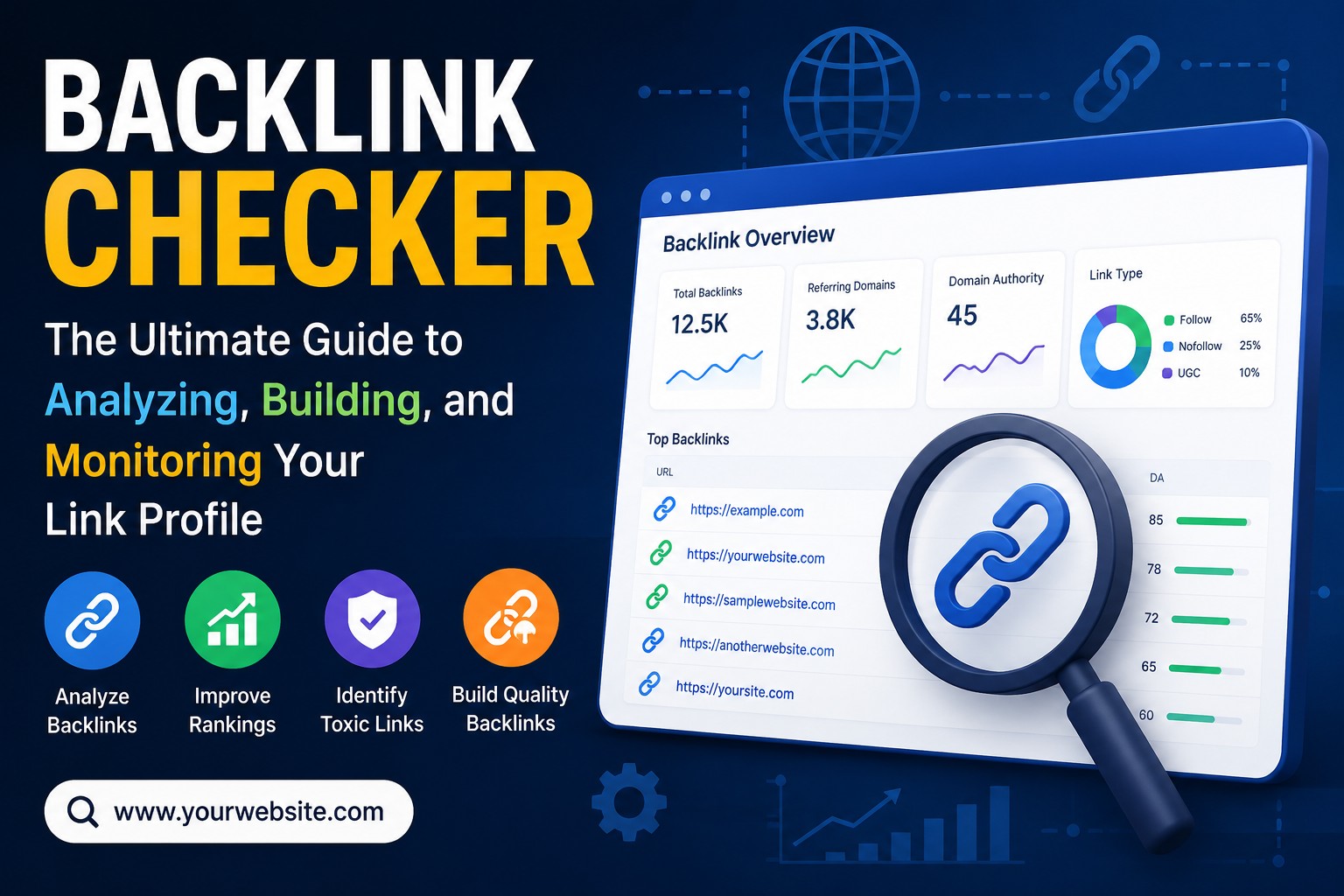
Backlink Checker: The Ultimate Guide to Analyzing, Building, and Monitoring Your Link Profile
If you have ever wondered why some websites rank on the first page of Google while others remain buried in obscurity, the answer often comes down to one powerful factor: backlinks. A backlink checker is the essential tool that gives you a clear window into your website’s link profile, your competitors’ strategies, and the overall authority your domain has built over time. Whether you are a seasoned SEO professional or a business owner just getting started with digital marketing, understanding how to use a backlink checker effectively can be the difference between a stagnant website and one that consistently climbs the search rankings.
This comprehensive guide walks you through everything you need to know about backlink checkers — what they are, why they matter, how tools like an afresh backlink checker work, where to find the best backlink checker sites, and how to put all of this knowledge into practice to grow your online presence.
What Is a Backlink Checker and Why Does It Matter?
A backlink checker is a software tool or online platform that crawls the web to identify all the external websites that are linking back to a particular domain or URL. These inbound links, commonly called backlinks, are one of the most heavily weighted ranking signals that search engines like Google use when deciding how to position pages in their results.
When a reputable website links to your content, it sends a signal to search engines that your page contains valuable, trustworthy information. The more high-quality backlinks you accumulate from authoritative sources, the more credibility your site gains in the eyes of search algorithms. Conversely, a collection of low-quality, spammy, or irrelevant backlinks can actually hurt your rankings and even trigger manual penalties from Google.
This is precisely why using a backlink checker is not optional for anyone serious about SEO — it is a fundamental part of ongoing website management. Without one, you are essentially navigating in the dark, with no way of knowing who is linking to you, what anchor text they are using, whether those links are helping or hurting you, or how your link profile compares to your competitors.
A reliable backlink checker gives you:
- A complete list of domains linking to your website
- The authority or trust score of each linking domain
- The anchor text being used in each link
- Whether links are follow or nofollow
- The status of each link (active, broken, or lost)
- Historical data showing link gains and losses over time
- Competitive analysis showing where rival websites are getting their links
With this information in hand, you can make strategic decisions about where to invest your link-building efforts, which toxic links to disavow, and how to replicate the backlink strategies that are working for your top competitors.
How Search Engines Use Backlinks as Ranking Signals
Before going deeper into specific tools and techniques, it is worth understanding the foundational logic behind why backlinks matter so much in SEO. Google’s original breakthrough came in the form of PageRank, an algorithm developed by Larry Page and Sergey Brin that treated hyperlinks between web pages as votes of confidence. A page that received many links from high-authority sources was considered more authoritative itself, and was therefore ranked higher.
While Google’s algorithm has become enormously more sophisticated since those early days — incorporating hundreds of ranking signals including user behavior, content quality, technical performance, and mobile usability — links remain one of the strongest and most reliable ranking factors. Multiple large-scale studies by organizations like Backlinko and Moz have consistently confirmed that the number and quality of backlinks pointing to a page are among the top predictors of its search ranking.
What has changed is how Google evaluates link quality. In the early days, any link was a good link, which led to widespread manipulation through link farms, purchased links, and private blog networks. Google’s Penguin algorithm update in 2012, and subsequent iterations of Penguin integrated directly into the core algorithm, dramatically changed this landscape. Today, Google is far more sophisticated at identifying unnatural link patterns, and a strategy built on low-quality link acquisition can do far more harm than good.
This makes a backlink checker even more critical, because you need to continuously monitor the quality of your incoming links, not just the quantity.
Backlink Checker: Core Features to Look For
Not all backlink checkers are created equal. The quality, depth, and reliability of the data they provide can vary significantly depending on the size of their link index, the frequency of their crawls, and the sophistication of their analysis features. When evaluating a backlink checker, here are the core features that distinguish a truly useful tool from a superficial one.
Index Size and Freshness
The most important factor determining the usefulness of any backlink checker is the size and freshness of its link index. A tool with a small or outdated index will miss huge numbers of backlinks, leaving you with an incomplete and potentially misleading picture of your link profile. Top-tier tools like Ahrefs, Semrush, and Moz maintain indices containing tens or hundreds of billions of known links, and they recrawl the web continuously to keep their data current.
Domain Authority Metrics
Every reputable backlink checker provides some form of domain authority score — a proprietary metric that attempts to predict how authoritative a linking domain is. Ahrefs calls this Domain Rating (DR), Moz calls it Domain Authority (DA), and Semrush uses the Authority Score. While these metrics are not identical and are not officially used by Google, they are valuable proxies for evaluating the relative quality of linking domains.
Anchor Text Analysis
Anchor text — the clickable words used in a hyperlink — plays an important role in how search engines interpret a backlink. A healthy backlink profile contains a natural mix of branded anchor text, generic anchor text, and a smaller proportion of keyword-rich anchors. Over-optimization of anchor text toward specific keywords is a red flag for Google and can trigger penalties. A good backlink checker breaks down your anchor text distribution in detail, allowing you to spot and correct any unnatural patterns.
Link Type Classification
Backlinks come in two fundamental types: dofollow and nofollow. Dofollow links pass PageRank and directly contribute to your rankings. Nofollow links include a special HTML attribute that instructs search engines not to pass link equity, though Google has indicated it treats nofollow as a hint rather than a directive, meaning some SEO value may still transfer. Additional link attributes include sponsored (used for paid or affiliate links) and UGC (user-generated content, used for links in comments and forums). A comprehensive backlink checker categorizes all incoming links by type.
Competitor Backlink Analysis
One of the most powerful applications of a backlink checker is competitive research. By entering a competitor’s domain into the tool, you can see exactly where their backlinks are coming from — giving you a ready-made list of link-building opportunities. If a website is willing to link to your competitor’s content, there is a reasonable chance they might link to yours as well, especially if you can offer something more comprehensive, more current, or more useful.
Lost and Broken Link Tracking
Links do not last forever. Websites get redesigned, pages get deleted, and domains expire. When a page that was linking to you gets removed or significantly changed, you lose that link equity. A good backlink checker tracks not only your current links but also recently lost links, giving you the opportunity to reach out to webmasters and request that the link be restored or updated.
Afresh Backlink Checker: A Modern Approach to Link Analysis
The term afresh backlink checker refers to a fresh, renewed, or up-to-date approach to analyzing your website’s backlink profile. In the world of SEO, where algorithm updates arrive frequently and link profiles change constantly, analyzing your backlinks afresh — that is, with current, live data and a clean analytical perspective — is absolutely essential.
An afresh backlink checker approach means going beyond simply looking at historical data and instead taking a comprehensive, present-tense view of your link profile. This involves:
Starting with a clean slate audit: Rather than relying on old reports or outdated analyses, an afresh backlink checker approach begins by pulling a completely fresh crawl of your current link profile. This ensures you are working with data that reflects the actual state of your backlinks today, not months ago.
Re-evaluating previously assessed links: Links that were considered high quality six months ago may now be coming from domains that have declined in authority, been penalized, or shifted to irrelevant niches. An afresh backlink checker reassesses these links with current metrics rather than assuming their quality has remained constant.
Identifying new link opportunities: Fresh analysis frequently uncovers linking opportunities that did not exist previously — new websites in your niche, recently published resource pages, updated industry directories, or competitor content that has attracted links you could also earn.
Spotting newly acquired toxic links: Negative SEO attacks, in which competitors or malicious actors point spammy links at your website to damage your rankings, can emerge suddenly. An afresh backlink checker approach involves regular, scheduled audits to catch these toxic links quickly before they accumulate and cause real harm.
Tools that support an afresh backlink checker workflow include those that allow you to schedule automated audits, receive email alerts when significant new links appear or disappear, and compare current snapshots with historical baselines to immediately identify anomalies.
Ahrefs, for instance, allows users to set up alerts that notify them whenever their website gains or loses links above a specified authority threshold. This kind of proactive monitoring is the essence of the afresh backlink checker philosophy — staying ahead of changes rather than discovering problems after they have already affected your rankings.
Web Backlink Checker: Understanding the Technology Behind the Tool
A web backlink checker operates by deploying automated crawlers — sometimes called spiders or bots — that systematically browse the internet, following links from page to page and recording information about each link they discover. This massive, continuous crawling operation is what allows web backlink checker tools to maintain their link databases.
Understanding how a web backlink checker works at a technical level helps you interpret its data more accurately and use it more effectively.
The Crawling Process
When a web backlink checker sends its crawler to a web page, the bot reads the page’s HTML source code and identifies all the hyperlinks present on that page. It records the source URL (where the link appears), the destination URL (where the link points), the anchor text, the link type (dofollow, nofollow, sponsored, UGC), and various other attributes. It then follows each of those outgoing links to new pages and repeats the process, building a continuously expanding map of the web’s link structure.
Link Index Management
The data collected through crawling is stored in a massive database called a link index. Because the web contains hundreds of billions of pages and trillions of individual links, no single web backlink checker can index everything. Each tool makes different choices about how frequently to recrawl known pages, which pages to prioritize, and how to handle newly discovered domains. These choices directly affect the completeness and freshness of the data you see when you use the tool.
Processing and Metric Calculation
Once links are crawled and indexed, the web backlink checker processes that raw data to calculate the authority and quality metrics that make the tool useful. This typically involves graph-based algorithms similar to PageRank that evaluate each domain’s position within the broader web graph — highly connected domains at the center of many authoritative link networks receive higher scores, while isolated or poorly connected domains receive lower scores.
Data Delivery to Users
When you enter a URL into a web backlink checker, the tool queries its database and returns the relevant results — the list of links pointing to that URL, the associated metrics, and any analytical insights the tool has generated from the raw data. The speed and depth of these results depend on how comprehensive the tool’s index is and how its database architecture is optimized for query performance.
Leading web backlink checker tools include:
- Ahrefs (ahrefs.com) — widely considered to have the largest and most frequently updated backlink index, with over 35 trillion known links
- Semrush (semrush.com) — a comprehensive SEO platform with powerful backlink analytics and a massive link database
- Moz Link Explorer (moz.com/link-explorer) — one of the original web backlink checker platforms, known for its Domain Authority metric
- Majestic (majestic.com) — specializes exclusively in link intelligence, with unique metrics including Trust Flow and Citation Flow
Backlink Checker Sites: The Top Platforms Reviewed
Finding the right backlink checker sites for your specific needs depends on your budget, the scale of your SEO operation, and the specific features you require. Here is a detailed review of the leading backlink checker sites available today.
Ahrefs — The Industry Standard
Ahrefs is widely regarded as the most powerful and comprehensive of all backlink checker sites. Its Site Explorer tool provides an extraordinarily detailed view of any domain’s or URL’s backlink profile, with data drawn from an index that the company claims is the world’s largest, updated with fresh crawls every 15 to 30 minutes.
Key features include a complete backlink report with filtering options, referring domain analysis, anchor text breakdown, link intersect tool (which shows you links that go to multiple competitors but not to you), broken link analysis, and a historical index that lets you see how a site’s link profile has evolved over time.
Ahrefs is a premium tool with no free tier for comprehensive backlink analysis, but it offers a trial and is considered worth the investment by most professional SEO practitioners.
You can explore Ahrefs at: https://ahrefs.com/backlink-checker
Semrush — All-in-One SEO Power
Semrush is another enterprise-grade platform that functions as one of the most capable backlink checker sites on the market. Its Backlink Analytics tool offers deep analysis of any domain’s link profile, while the Backlink Audit tool specifically helps identify toxic or potentially harmful links and generate disavow files.
One of Semrush’s standout features in the backlink space is its Backlink Gap tool, which performs competitor link analysis at scale — showing you exactly which domains are linking to multiple competitors simultaneously but not yet linking to you. This makes it one of the most valuable backlink checker sites for strategic link-building prospecting.
Semrush offers limited free searches per day and full access through paid subscriptions. Learn more at: https://www.semrush.com/analytics/backlinks/
Moz Link Explorer — Trusted Metrics, User-Friendly Interface
Moz has been a fixture in the SEO world since the early days of the industry, and its Link Explorer tool remains one of the most trusted backlink checker sites available. It introduced the Domain Authority metric that has since been widely adopted as an industry standard for quickly assessing a domain’s linking power.
Moz Link Explorer provides a solid set of features including a complete backlink report, spam score analysis (which flags potentially harmful links), anchor text analysis, and the ability to track how your link profile compares to competitors. Moz offers a free tier with limited monthly link queries and full access through its Moz Pro subscription.
Visit Moz Link Explorer at: https://moz.com/link-explorer
Majestic — The Link Specialist
Majestic occupies a unique position among backlink checker sites in that its entire focus is link intelligence rather than broader SEO analytics. It does not offer keyword research, site auditing, or rank tracking — its sole purpose is providing the deepest possible analysis of web link structures.
Majestic is known for two proprietary metrics: Trust Flow, which measures link quality based on how close a site is to a set of curated, highly trusted seed sites, and Citation Flow, which measures the sheer volume of links pointing to a domain. The ratio between these two metrics — known as the Trust Ratio — is a particularly useful indicator of link profile quality.
Majestic offers a free tier with limited data and comprehensive access through paid plans. Explore it at: https://majestic.com
Google Search Console — Free and Direct from the Source
While not a traditional backlink checker in the way the tools above are, Google Search Console deserves mention as a free resource that shows you links to your site directly from Google’s own index. The Links report within Search Console shows your top linking sites, most linked pages, and most common anchor text.
The limitation of Search Console as a backlink checker is that it shows you only a sample of your links, not a comprehensive dataset, and it provides no quality metrics or competitive analysis. However, its data is directly from Google and is therefore highly accurate for the links it does show. It is an essential free complement to any paid backlink checker tool.
Access Google Search Console at: https://search.google.com/search-console
Ubersuggest — Budget-Friendly Option
For smaller websites and businesses with limited budgets, Ubersuggest by Neil Patel offers a more affordable entry point into the world of backlink checker sites. It provides a reasonable view of a domain’s backlink profile with data on domain authority, anchor text, and referring domains, though its index is significantly smaller than Ahrefs or Semrush.
Ubersuggest offers a free tier with daily limits and low-cost paid plans, making it one of the most accessible backlink checker sites for beginners. Find it at: https://neilpatel.com/ubersuggest/
How to Conduct a Backlink Audit Using a Backlink Checker
Now that you understand what a backlink checker is and where to find the best backlink checker sites, let us walk through the practical process of conducting a comprehensive backlink audit. This is the foundational activity that should inform all of your link-building strategy.
Step 1 — Crawl Your Full Backlink Profile
Begin by entering your domain into your chosen backlink checker and pulling a complete export of all backlinks. Depending on the age and size of your site, this could range from a few dozen links to hundreds of thousands. Export the full dataset to a spreadsheet for analysis.
Step 2 — Evaluate Domain Authority of Linking Sites
For each link in your profile, note the Domain Authority or Domain Rating of the linking site. Links from high-authority, reputable sites are your most valuable assets. Links from low-authority or unrecognized domains deserve closer scrutiny.
Step 3 — Assess Link Relevance
Authority alone is not enough — relevance matters too. A link from a high-authority website in a completely unrelated niche carries less SEO value than a link from a moderate-authority site in your exact niche. Review the source pages of your backlinks to assess topical relevance.
Step 4 — Identify Toxic Links
Look for patterns that suggest manipulative or low-quality links: links from domains with spam scores above 50 percent, links with overly aggressive exact-match anchor text, links from link farms or private blog networks, links from foreign-language sites with no topical connection, and links from domains that have been penalized by Google.
Step 5 — Create a Disavow File for Harmful Links
For any links that appear genuinely harmful and that you cannot remove by contacting the linking webmaster, compile them into a disavow file and submit it through Google Search Console. This instructs Google to ignore those links when evaluating your site.
Step 6 — Identify Your Best Links and Replicate
Your backlink checker will reveal which pages on your site have attracted the most high-quality links. Analyze why those pages earned links — is it the content format, the data they contain, the comprehensiveness of the information, or their novelty? Use these insights to inform your future content strategy.
Step 7 — Analyze Competitor Backlink Profiles
Enter your top three to five competitors’ domains into your backlink checker and export their link profiles. Look for patterns — which websites are linking to multiple competitors? Which content formats attract the most links in your niche? Which link-building tactics are most prevalent? This competitive intelligence directly informs your outreach and content strategy.
Building High-Quality Backlinks: Strategies Informed by Your Backlink Checker
A backlink checker does not just help you analyze your existing links — it actively informs your strategy for building new ones. Here are the most effective white-hat link-building approaches, all enhanced by insights from your backlink checker.
Digital PR and Data-Driven Content
One of the most reliable ways to earn high-authority links at scale is to create genuinely newsworthy, data-driven content that journalists, bloggers, and industry publications want to reference. This could be original research, industry surveys, proprietary data analysis, or unique visualizations. Your backlink checker reveals which pieces of content in your niche have earned the most links, pointing you toward the formats and topics most likely to attract coverage.
Broken Link Building
Broken link building is a technique in which you use your backlink checker to find pages that are linking to content on other websites that no longer exist. You then create equivalent content on your own site and reach out to the linking webmasters to suggest replacing the broken link with a link to your content. This technique works because it offers a concrete benefit to the webmaster — you are helping them fix a problem on their site.
The Skyscraper Technique
Popularized by Brian Dean of Backlinko, the Skyscraper Technique involves finding existing content in your niche that has already attracted many backlinks, creating a significantly better version of that content, and then reaching out to everyone who linked to the original to tell them about your superior resource. Your backlink checker makes this approach highly systematic — you can identify the most linked-to content in your niche in minutes.
Resource Page Link Building
Many websites in almost every niche maintain resource pages — curated lists of the best tools, guides, websites, or references on a given topic. These pages can be goldmines for link building because they exist specifically to link out to quality content. Use your backlink checker to find resource pages in your niche by studying where competitors’ top links are coming from, then reach out to be included.
Guest Posting on Authority Sites
Contributing high-quality articles to respected publications in your niche remains one of the most effective link-building strategies when done correctly. The key is to focus on genuine editorial placements on sites that have real traffic and high domain authority, not low-quality sites that exist primarily to sell links. Your backlink checker helps you identify which publications in your niche are considered authoritative based on their domain metrics and the quality of sites linking to them.
HARO and Expert Roundups
Help a Reporter Out (HARO) and similar services (like Qwoted and SourceBottle) connect journalists and bloggers who need expert sources with knowledgeable professionals who can provide them. Consistently responding to relevant queries with insightful, well-written responses can earn you links from major news publications and industry blogs. These links tend to carry significant authority and drive direct referral traffic as well.
Common Backlink Checker Mistakes to Avoid
Even with the best backlink checker tools at your disposal, it is easy to misinterpret data or draw incorrect conclusions. Here are the most common mistakes to avoid.
Obsessing over quantity instead of quality: A website with 100 links from genuinely authoritative, relevant sources will almost always outperform a site with 10,000 links from low-quality directories. Do not use your backlink checker to chase raw link numbers — focus on quality.
Ignoring nofollow links entirely: While nofollow links do not pass link equity in the traditional sense, they are not without value. They drive referral traffic, they indicate that real humans found your content worth sharing, and Google’s own statements suggest nofollowed links are treated as hints rather than absolute directives.
Failing to monitor competitors regularly: Your competitors are not standing still. Running a competitive backlink analysis once and never revisiting it means you will miss new link-building strategies they are deploying. Schedule regular competitor audits in your backlink checker.
Disavowing links too aggressively: Not every low-quality link is worth disavowing. Google’s algorithms are sophisticated enough to ignore many low-quality links without any action on your part. Excessive disavowal can actually harm your rankings by removing links that were providing some benefit.
Ignoring anchor text diversity: Your backlink checker’s anchor text report should reveal a natural-looking mix of branded terms, generic phrases, naked URLs, and a limited proportion of keyword-rich anchors. If your anchor text profile is heavily skewed toward exact-match keywords, this is a manipulation signal that may trigger algorithmic or manual penalties.
Integrating Your Backlink Checker Into an Ongoing SEO Workflow
A backlink checker is most valuable not as a one-time diagnostic tool but as a core component of an ongoing SEO monitoring workflow. Here is how to integrate it effectively.
Weekly monitoring: Check your backlink checker at least once per week for significant new links gained or lost. Quickly losing many links from a single domain may indicate that domain has restructured its site. Gaining sudden spikes of low-quality links may indicate a negative SEO attack.
Monthly audits: Conduct a thorough audit of your full link profile every month, re-evaluating the quality of existing links, identifying new toxic links that may have appeared, and tracking progress toward link-building goals.
Quarterly competitive analysis: Every quarter, pull fresh reports from your backlink checker on your top competitors. Look for new link sources they have acquired, new content formats they are publishing, and new partnerships or PR campaigns they have undertaken.
Pre- and post-campaign analysis: Before launching any major content marketing or PR campaign, use your backlink checker to establish a baseline. After the campaign, pull fresh data to measure how many new links it generated and from which types of sources.
The Future of Backlink Checkers and Link Analysis
The technology behind backlink checkers continues to evolve rapidly. Several trends are shaping where these tools are headed.
AI-powered link quality assessment: Machine learning is making it possible for backlink checker tools to assess link quality far more nuanced than simple authority scores. Future tools will likely be able to evaluate the actual content context of a link, the behavioral signals associated with the linking page, and the semantic relevance between the source and destination pages.
Real-time link monitoring: The gap between when a link appears on the web and when it appears in a backlink checker’s database continues to shrink. Tools like Ahrefs already update their index within hours for high-priority domains, and this real-time capability will eventually extend across the full web.
Integration with content and outreach platforms: The best backlink checker tools are increasingly integrating with content marketing platforms, CRM systems, and email outreach tools to create seamless end-to-end workflows for link building campaigns.
Greater emphasis on link placement quality: Future iterations of backlink checker tools will likely provide more granular data about where exactly on a page a link appears, whether it is surrounded by relevant content, and whether it is likely to receive human clicks — all factors that influence the real-world SEO value of the link.
Conclusion: Making the Backlink Checker Central to Your SEO Strategy
The backlink checker is not just a diagnostic tool — it is a strategic compass that guides your entire approach to building authority, earning rankings, and growing your organic search presence. Whether you are using an afresh backlink checker workflow to keep your link analysis current, relying on a web backlink checker to understand the technical mechanics of your link profile, or evaluating different backlink checker sites to find the right tool for your needs, the fundamental value is the same: clear, actionable intelligence about one of SEO’s most powerful ranking signals.
The websites that consistently rank at the top of competitive search results are not there by accident. They have typically invested heavily in understanding their link profiles, systematically earning high-quality links from authoritative sources, monitoring and removing toxic links before they cause damage, and continuously studying and learning from the link-building strategies of their competitors. All of this is made possible by the consistent, disciplined use of a backlink checker.
Invest in the right backlink checker for your business, build a regular monitoring and analysis routine around it, and use the insights it provides to drive strategic, sustainable link building. Done right, this approach will compound over time into a link profile that becomes one of your most durable competitive advantages in search.
For further reading on backlink analysis and link-building strategy, explore the resources available at Ahrefs Blog (ahrefs.com/blog), Moz’s Beginner’s Guide to SEO (moz.com/beginners-guide-to-seo), and Backlinko’s SEO Hub (backlinko.com/hub/seo).