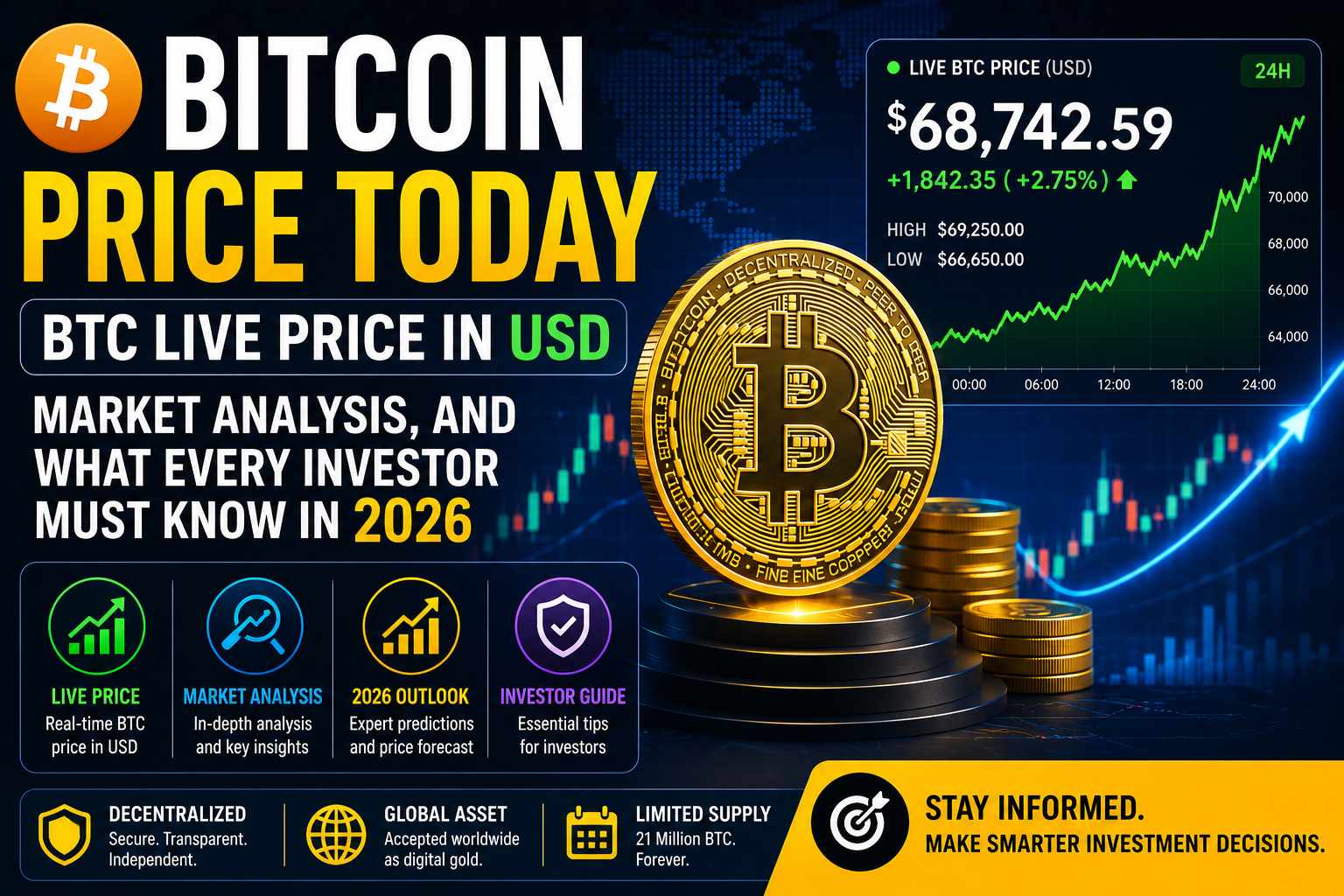
Bitcoin Price Today: BTC Live Price in USD, Market Analysis, and What Every Investor Must Know in 2026
Published: June 3, 2026 | Category: Cryptocurrency, Investing | Reading Time: ~14 minutes
The Bitcoin Price Today is making global headlines again — but not for the reasons bulls were hoping. After reaching a jaw-dropping all-time high of approximately $126,000 in October 2025, Bitcoin (BTC) has entered a prolonged correction phase, with the Bitcoin price today hovering between $67,000 and $70,000 as of June 2–3, 2026. That represents a pullback of more than 45% from peak levels in under nine months — a move that has rattled new investors, tested the conviction of veterans, and sparked intense debate about where the Bitcoin price in USD is headed next.
Whether you are checking the BTC price for the first time or you are a seasoned holder trying to navigate the current correction with a clear head, this guide covers everything you need: what is happening to the Bitcoin price today, why BTC is falling, what the on-chain and ETF data are signaling, and what the most credible analysts project for the remainder of 2026 and beyond. Let us get into it.
Bitcoin Price Today: Live BTC/USD Data and What the Numbers Mean Right Now
Bitcoin Price Overview (BTC/USD)
The Bitcoin price has fallen substantially from yesterday and continues sliding further as of early June trading. As one analyst note from Yahoo Finance put it plainly, investors are moving out of crypto amid continued market uncertainty, and as higher-performing sectors — such as artificial intelligence — offer alternatives. Spot Bitcoin ETFs recorded $1.42 billion in outflows as investor sentiment turns risk-off, compounding the technical selling pressure.
Real-Time BTC Chart & Price Trackers
For the most up-to-the-minute Bitcoin price metrics and deep technical charts, monitor these top industry infrastructure platforms.
Bitcoin: What Is It and Why Does the BTC Price Matter?
Before unpacking today’s price action, it is worth establishing the fundamentals — because they are precisely what long-term holders point to when short-term prices fall.
Bitcoin (BTC) is the world’s first decentralized cryptocurrency, created by the pseudonymous Satoshi Nakamoto. The first block was mined on January 3, 2009. Bitcoin operates on a peer-to-peer network in which participants can transfer BTC directly to each other without relying on intermediaries like banks or governments. The history of all transactions is stored on the Bitcoin blockchain, a public ledger secured and updated by a distributed network of computers called nodes.
A process called mining secures the network and issues new coins. Miners use specialized hardware to solve mathematical problems that confirm transaction validity. When a block of transactions is successfully verified, the miner receives a block reward in newly issued BTC along with transaction fees. This process also controls the rate at which new Bitcoin enters circulation — a feature by design.
The total supply of Bitcoin is permanently capped at 21 million coins. No central bank, government, or corporation can change that number. Currently, approximately 20.04 million BTC are in circulation, meaning roughly 960,000 coins remain to be mined over the coming century.
This hard cap is the foundation of Bitcoin’s value proposition as “digital gold” — a store of value that cannot be inflated away by monetary policy decisions. Its market capitalization of roughly $1.35 trillion makes it the largest cryptocurrency by a considerable margin, far ahead of second-ranked Ethereum at approximately $233 billion.
For a foundational resource on how Bitcoin works, Bitcoin.org — the original website maintained by the Bitcoin community — remains the most authoritative non-commercial starting point.
Bitcoin Price History: From Pennies to $126,000 and Back
Understanding the Bitcoin price today requires context from its full price history. What feels like an alarming correction in isolation looks very different across the full timeline of BTC’s price development.
2009–2010: Bitcoin begins trading at fractions of a cent. By February 2011, it reaches parity with the U.S. dollar for the first time — a milestone that felt extraordinary at the time.
2013: BTC surges past $1,000 for the first time before crashing back to the low hundreds.
2017: The first major retail mania carries Bitcoin above $20,000 in December before a prolonged bear market drags it back below $4,000 by late 2018.
2020–2021: Institutional adoption begins in earnest, with companies like MicroStrategy and Tesla adding Bitcoin to their balance sheets. The Bitcoin price in USD crosses $60,000 for the first time in early 2021, reaching an all-time high of $64,863 in April 2021 before correcting sharply.
2022: The FTX collapse and broader crypto contagion drive Bitcoin below $16,000 in November — a devastating loss of over 75% from the prior peak.
2023–2024: A slow recovery builds momentum. The approval of spot Bitcoin ETFs by the U.S. Securities and Exchange Commission in January 2024 opens the floodgates of institutional capital and provides a major structural catalyst.
2025: The Bitcoin price enters its most powerful bull run. Following the fourth Bitcoin halving in April 2024, BTC surges past $100,000 in late 2024, touches $110,000 in early 2025 on expectations of a pro-crypto regulatory environment following the Trump administration’s inauguration, and ultimately reaches an all-time high of approximately $126,000 in October 2025 according to TradingView data.
2025–2026 (Correction): By December 2025, the price had slipped back below $90,000, which caught many traders off guard. The correction has continued into 2026, with the Bitcoin price today sitting near $67,000–$70,000 — more than 45% below the peak.
From $2 at its lowest recorded point in October 2011 to $126,000 at its most recent all-time high, Bitcoin is still up more than 102,000% in percentage terms. That context does not eliminate current risk, but it does calibrate how alarming any individual correction truly is.
Why Is the Bitcoin Price Falling? Six Reasons Behind the 2026 Correction
The current Bitcoin price decline is not the result of a single event. It reflects a convergence of macroeconomic, geopolitical, regulatory, and market-structure pressures. Here is a breakdown of each driver:
1. Geopolitical Tensions and Risk-Off Sentiment
The most immediate trigger for the recent acceleration of the BTC price decline is geopolitical uncertainty. Escalating tensions between the United States and Iran — stemming from the U.S.-Israeli military conflict — have triggered a broader risk-off move across cryptocurrency markets. When geopolitical risk spikes, institutional investors typically reduce exposure to high-volatility assets like Bitcoin and rotate toward safe-haven alternatives such as U.S. Treasury bonds and gold.
Bitcoin has retreated from May highs as more than $2 billion exited U.S. spot Bitcoin ETFs amid geopolitical tensions, inflation concerns, and shifting Federal Reserve expectations.
2. Spot Bitcoin ETF Outflows
One of the most important institutional signals in the current market is ETF flow data. U.S. spot Bitcoin ETFs recorded $2.43 billion in net outflows during May 2026 alone — the largest monthly outflow figure of the year. Notable single-day outflows included $635 million on May 13, $649 million on May 18, and a particularly heavy $733 million on May 27.
As a result, 2026 net inflows have fallen to just $536 million — a steep slowdown for a market that investors had watched closely as a barometer for fresh institutional capital. Despite the recent reversal, cumulative inflows since the January 2024 ETF launch remain strongly positive at approximately $55.66–$58.72 billion, which provides important long-term context.
BlackRock’s iShares Bitcoin Trust (IBIT) — the dominant product in the space — has continued to lead the market but shed $448 million in a single session during the worst of the outflow streak. For ongoing ETF flow tracking, SoSoValue’s Bitcoin ETF data dashboard is one of the most granular public resources available.
3. Federal Reserve and Inflation Uncertainty
Broader macroeconomic uncertainty around Federal Reserve policy continues to weigh on speculative assets. When global liquidity contracts, speculative assets like Bitcoin suffer first. The jet fuel of any Bitcoin bull run is cheap money and expanding liquidity. With the Fed maintaining a cautious stance and inflation remaining a concern for market participants, risk appetite across equities and crypto has been constrained.
4. European Regulatory Pressure (MiCA)
On the regulatory front, Europe increased pressure through MiCA — the Markets in Crypto-Assets regulation. Crypto firms operating in the EU must secure licenses before July 1, 2026, or risk losing access to European customers. Regulators in France recently warned that non-compliant companies could face enforcement action or blacklisting. Because Bitcoin reacts strongly to uncertainty, major regulatory announcements often trigger volatility, increase investor caution, and contribute to short-term market sell-offs.
5. Post-Halving Cycle Behavior
History shows that Bitcoin tends to pick up momentum within 12 to 18 months after its halving. After this comes a prolonged cooling phase. The same pattern was repeated after the 2024 Bitcoin halving, which was followed by a price rally in May 2025, driving BTC over $100,000. By this reading, the correction now underway is historically normal behavior — a post-peak retracement that has occurred in every previous Bitcoin cycle.
In previous cycles, Bitcoin has corrected from peak levels regardless of improving fundamentals. While the market has matured, leverage, derivatives, ETFs, and institutional participation have also amplified downside risk during risk-off periods.
6. Whale Activity and Leveraged Liquidations
Finally, the mechanical dynamics of the derivatives market play a role. Bitcoin usually falls when several pressures hit at once. In the latest decline, macro fears, ETF outflows, whale activity, leveraged liquidations, regulatory uncertainty, and weak technical levels all pushed BTC lower. Large holders selling — combined with cascading liquidations of leveraged long positions — can accelerate corrections well beyond what fundamentals alone would justify.
Bitcoin Price USD: Key Technical Levels to Watch Right Now
For traders and active investors monitoring the Bitcoin price in USD, certain technical price levels carry outsized significance in June 2026.
Immediate Support Zone: $65,000–$67,000 This range has served as a support area during the current correction. A decisive break below $65,000 would be technically bearish and could open the path toward the next support cluster.
Secondary Support: $58,000–$62,000 Some analysts are predicting that the Bitcoin price could drop below $50,000 in 2026. According to them, this would not be a result of the project’s failure but from overlapping pressures that slowly erode speculative demand and bullish sentiment. The $58,000–$62,000 range represents a critical area where longer-term buyers have historically stepped in.
Resistance to Watch: $76,500–$78,000 Based on the current chart structure, the Bitcoin price forecast for June 2026 points to a possible recovery toward $76,500–$78,000 by June 30, if BTC reclaims the relevant EMA cluster. However, RSI near 34 shows weak momentum.
Breakout Level: $85,000–$90,000 A confirmed breakout above $85,000–$90,000 would be required before BTC can target higher resistance zones near $100,000–$110,000. Analysts broadly agree that reclaiming the $90,000 level is the first prerequisite for a renewed bull trend.
All-Time High: $126,080–$126,272 Bitcoin (BTC) reached its highest price on October 6, 2025, at approximately $126,272 USD according to TradingView. The market is currently trading more than 44% below that peak.
Market Analytics & Advanced Charting
For professional charting tools and deep technical analysis, these two institutional-grade platforms provide the critical depth of data that serious traders rely on to manage risk.
BTC/USD Advanced Market Geometry
High-precision candlestick data, custom indicators (RSI, MACD), and real-time order flow tracking direct from global liquidity pools.
Blockchain Analytics & Whale Activity
Deep-dive network telemetry mapping exchange inflows/outflows, realized cap distribution, and long-term holder accumulation matrices.
Bitcoin Price Today vs. One Year Ago: The Bigger Picture
The Bitcoin price today of approximately $67,000–$69,000 can feel disorienting when compared to the October 2025 high of $126,000. But compared to one year ago — June 2025 — the picture shifts significantly.
According to Fortune’s price data, the current Bitcoin price represents about a $36,650 decline compared to the price one year ago. That means BTC is still trading at elevated levels relative to where it was during much of the 2024–2025 buildup phase, when Bitcoin crossed $60,000, $80,000, and $100,000 for the first time on its way to the peak.
For long-term holders who entered positions below $50,000 — or well below that — the current “crash” still represents a substantial return on their investment. The emotional weight of seeing prices fall 45% from a peak is real, but the mathematical context matters considerably.
Bitcoin Price Prediction 2026: What Analysts Are Saying
With the Bitcoin price today well below its peak, the most-searched question among investors is inevitably: where does BTC go from here? Here is a comprehensive overview of analyst and institutional forecasts for the remainder of 2026:
Bullish Scenarios
Tom Lee (Co-founder, Fundstrat Global Advisors) maintains a bullish long-term view, suggesting Bitcoin could reach new all-time highs in early-to-mid 2026, focusing on macro liquidity cycles and the continued maturation of the institutional market.
Structural bulls argue that Bitcoin’s longer-term market structure is increasingly driven by institutional capital flows rather than speculative retail activity alone. They point to the sustained $55.66 billion in cumulative ETF inflows since January 2024 as evidence of a permanent shift in how major financial institutions treat Bitcoin as an asset class. Bank of America, for example, has steadily increased its IBIT holdings to 972,590 shares.
The XS.com forecast sets 2026 targets in the $150,000–$250,000 range based on historical halving cycle analysis, though it acknowledges that near-term consolidation remains the dominant regime.
Base Case / Cautiously Bullish
CoinDCX analysts project a wide trading range of $70,000–$110,000 through much of 2026. A confirmed breakout above $85,000–$90,000 would be needed before BTC can target $100,000–$110,000. Momentum indicators are improving, but long-term EMAs still show resistance.
Flitpay analysis estimates BTC can trade between $58,000 and $125,000 in 2026, depending on whether global tensions ease and macroeconomic conditions improve. They note that Trump’s pro-Bitcoin stance and the U.S. strategic crypto reserve decision have helped but are not yet bullish enough on their own to guarantee a new all-time high this year.
Bearish Scenarios
Sean Farrell (Head of Digital Asset Strategy, Fundstrat) projects a base case retracement to $60,000–$65,000 in H1 2026 as a risk management position — a range the market is currently approaching or touching.
Mitrade analysts note that some forecasters see Bitcoin sliding further toward $50,000 or lower, driven by overlapping pressures: macro liquidity contraction, continued ETF outflows, regulatory uncertainty, and the natural cooling phase following a halving-driven peak.
The honest summary: credible forecasts for Bitcoin price in 2026 range from approximately $50,000 on the bearish end to $250,000 on the most optimistic projections. No model — however sophisticated — can account for black swan events, regulatory shocks, or macro surprises. Bitcoin’s history is full of unpredictable shocks: Mt. Gox (2014), China’s mining ban (2021), and the FTX collapse (2022) all blindsided markets.
Bitcoin Price and Institutional Adoption: The Long-Term Structural Story
Despite the current correction, the long-term institutional adoption story underlying the Bitcoin price has not reversed — it has only paused. Here is the structural picture that matters for anyone with a multi-year time horizon:
Spot Bitcoin ETFs launched in January 2024 and have accumulated approximately $55–$58 billion in cumulative net inflows, establishing Bitcoin as a mainstream institutional asset. BlackRock’s IBIT and Fidelity’s FBTC have become two of the most successful ETF launches in financial history.
The U.S. Government’s Stance has shifted dramatically. The Trump administration has positioned itself as pro-crypto, including establishing a U.S. strategic Bitcoin reserve — a decision with significant long-term implications for government-level demand and validation of Bitcoin as a reserve asset.
Corporate Treasury Adoption continues to grow. Companies following MicroStrategy’s lead have added Bitcoin to their corporate treasuries, creating a structural buyer base that is largely price-insensitive on a quarter-to-quarter basis.
The 2024 Halving Effect cut Bitcoin’s block reward from 6.25 BTC to 3.125 BTC, reducing new supply issuance by 50%. The current block reward is 3.13 BTC per block. With 20.04 million of the 21 million total supply already mined, new issuance is permanently dwindling — a supply dynamic that, over multi-year time horizons, has historically driven price appreciation.
The GENIUS Act and Regulatory Clarity — legislative efforts in the United States to establish a clear framework for stablecoins and digital assets — have provided a foundation of regulatory certainty that was absent during previous Bitcoin cycles. Institutional participation at scale is impossible without such clarity, and its gradual emergence is a structural positive.
How to Track the Bitcoin Price USD: Best Tools and Resources
Given the 24/7 nature of cryptocurrency markets, having reliable tools to monitor the Bitcoin price today is essential. Here are the most authoritative and widely used platforms:
For Live Price and Market Data:
- CoinMarketCap — the most widely cited market data aggregator, updated in real time.
- CoinGecko — comprehensive data including on-chain metrics, trading volume, and historical performance.
- CoinDesk Markets — the industry’s leading news outlet also publishes live price data.
For Technical Analysis and Charting:
- TradingView BTC/USD — the professional trader’s standard for charting, with RSI, MACD, moving averages, and hundreds of custom indicators.
- Glassnode — on-chain analytics platform tracking miner activity, wallet addresses, and holder behavior.
For ETF Flow Data:
- SoSoValue Bitcoin ETF Tracker — real-time inflow and outflow tracking for all U.S. spot Bitcoin ETFs.
For Buying BTC:
- Coinbase — the most regulated and beginner-friendly U.S.-based exchange.
- Kraken — long-established, security-focused exchange with competitive fees.
- Binance — the world’s largest exchange by trading volume, offering deep liquidity and extensive trading pairs.
Bitcoin Price Risk Factors Every Investor Must Understand
Any responsible discussion of the Bitcoin price must acknowledge the real and significant risks involved in holding or trading BTC:
Volatility: A $143,000 target is compelling, but Bitcoin could plunge 30% on the way there. The recent drop from $126,000 to $88,000 demonstrates this volatility remains very much alive. Bitcoin is not a stable store of value in the short term — it is one of the most volatile assets in the world by any standard measure.
Regulatory Risk: Policy shifts can accelerate adoption or freeze momentum overnight. While the U.S. has provided significant clarity, global regulatory developments remain unpredictable. MiCA in Europe, potential crackdowns in Asia, and evolving SEC guidance can all move markets dramatically.
Black Swan Events: Bitcoin’s history is full of unpredictable shocks. No model can account for exchange failures, protocol vulnerabilities, or geopolitical escalations. The FTX collapse wiped 75% off the price in under a year.
Liquidity Risk: During sharp sell-offs, even large Bitcoin markets can become illiquid very quickly as bid-ask spreads widen and exchanges experience load issues.
Custody Risk: Unlike traditional investments, Bitcoin held on exchanges is not insured by the FDIC or SIPC. If an exchange fails or is hacked, funds may be permanently lost. Hardware wallets and self-custody are the recommended approach for significant holdings.
Opportunity Cost: As AI stocks, clean energy investments, and other growth sectors continue producing strong returns, opportunity cost has become a genuine consideration for investors allocating capital to a currently correcting asset.
Demystifying the Decentralized Web
Curious about how distributed ledgers are shifting power away from tech giants? Dive into our comprehensive guide to understand the architecture, security, and real-world impact of the chain.
Blockchain Technology Explained — Read the Full GuideBitcoin Price Today: Frequently Asked Questions
Q: What is the Bitcoin price right now? As of June 2–3, 2026, the Bitcoin price is approximately $67,000–$69,500 USD depending on the platform and time of day. Check CoinMarketCap for live pricing.
Q: What is Bitcoin’s all-time high? Bitcoin reached approximately $126,080–$126,272 in October 2025, its highest price on record.
Q: Why is Bitcoin dropping today? The current decline reflects a combination of geopolitical uncertainty from the U.S.-Iran conflict, heavy ETF outflows ($2.43 billion in May 2026), Federal Reserve uncertainty, European MiCA regulatory pressure, and post-halving cycle cooling.
Q: Is Bitcoin a good investment in 2026? This depends entirely on your risk tolerance, time horizon, and financial situation. Analysts project 2026 trading ranges from as low as $50,000 to as high as $250,000. No one can predict prices reliably. Always consult a licensed financial advisor before investing.
Q: How much Bitcoin is left to be mined? Approximately 960,000 BTC remain to be mined, out of the total hard cap of 21 million. The current circulating supply is approximately 20.04 million coins.
Q: What is the Bitcoin market cap today? Approximately $1.35–$1.39 trillion USD as of June 2–3, 2026, making it the #1 ranked cryptocurrency by market capitalization.
Q: Where can I buy Bitcoin? Coinbase, Kraken, and Binance are among the most widely used and regulated platforms for purchasing BTC in the United States.
Final Thoughts on Bitcoin Price, BTC Outlook, and What to Do Now
The Bitcoin price today tells a story of a market caught between two competing forces: the powerful, long-term structural tailwinds of institutional adoption, regulatory clarity, and supply scarcity — and the very real near-term headwinds of geopolitical instability, ETF outflows, macro tightening, and post-halving cycle normalization.
Bitcoin (BTC) has been declared dead more than 400 times throughout its history. It has survived exchange collapses, government bans, 90% corrections, and regulatory sieges. Each time, it has recovered and ultimately reached new highs. That record does not guarantee future performance — but it does establish a remarkable historical pattern.
The Bitcoin price in USD will remain volatile. Expect a wide trading range between $70,000 and $110,000 through much of 2026, with breakout potential above $85,000–$90,000 if macro conditions improve. The fundamental case — 21 million hard-capped supply, growing institutional ownership, expanding ETF infrastructure, and a U.S. government that now views Bitcoin as a strategic asset — remains intact.
For investors, the lessons from every previous cycle are consistent: volatility is the price of admission, position sizing matters enormously, and decisions made during periods of maximum fear tend to look very different in hindsight. If you are holding Bitcoin through this correction, do not make decisions based on a single day’s price action. If you are considering buying, understand the risks fully before entering.
Essential Bitcoin Intelligence Toolkit
Stay informed by bookmarking these critical industry standouts. Together, these three platforms provide the most complete picture of what the Bitcoin price is doing and why.
Disclaimer: This article is for informational and educational purposes only and does not constitute financial, investment, or legal advice. Cryptocurrency investments carry significant risk, including the possible loss of your entire investment. Always conduct your own research and consult a licensed financial professional before making any investment decisions. Bitcoin prices referenced in this article reflect data from June 2–3, 2026, and are subject to change.