SpaceX Stock Price, SPCX IPO Date, and How to Buy Space Exploration Technologies Corp — The Complete 2026 Guide
Published: June 5, 2026 | Category: Investing, IPO News, Space Technology | Reading Time: ~15 minutes
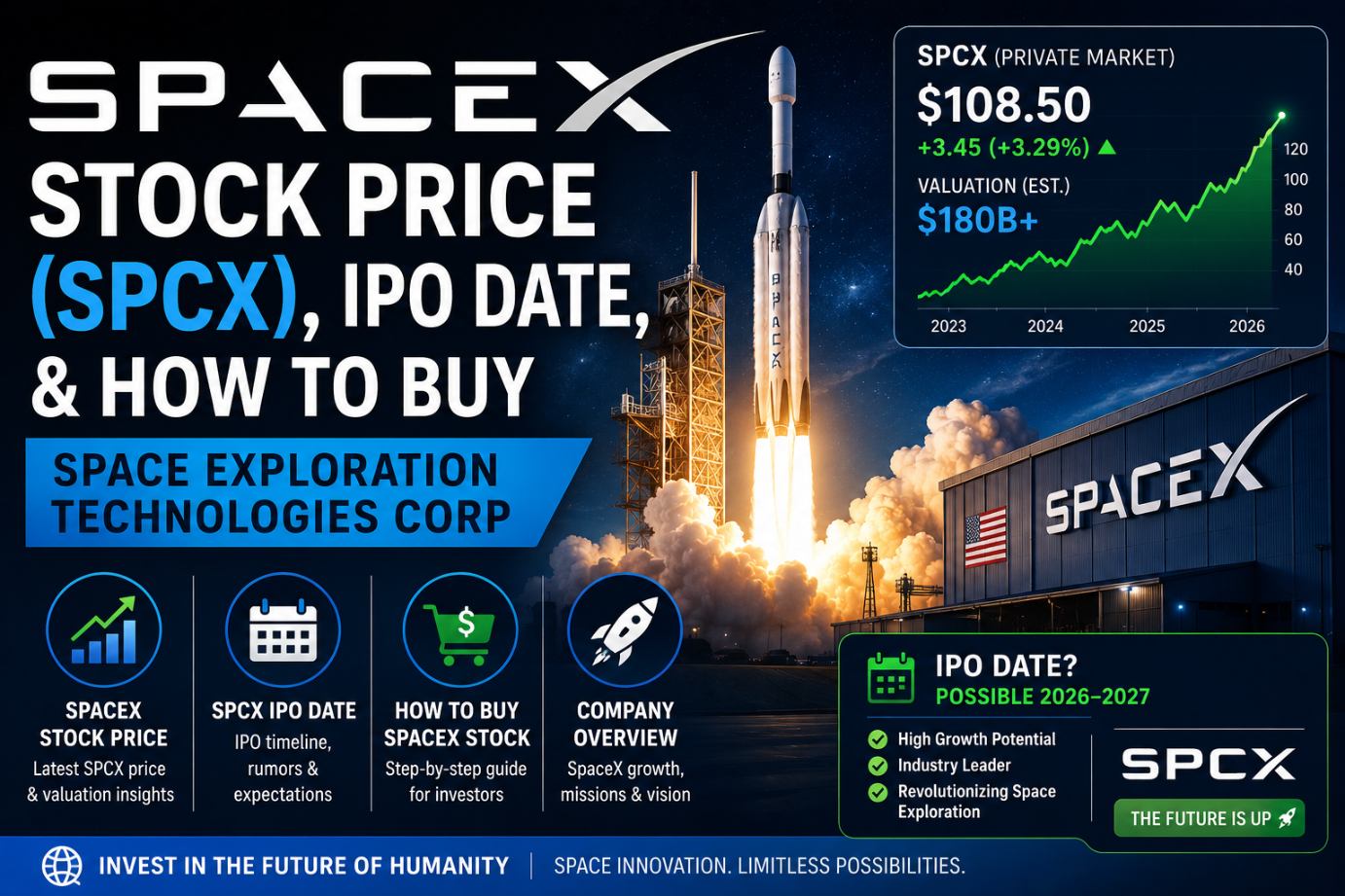
The most anticipated stock market debut in modern history is days away. SpaceX stock price discussions have dominated financial media since Elon Musk’s Space Exploration Technologies Corp. publicly filed its S-1 registration statement with the U.S. Securities and Exchange Commission on May 20, 2026 — and the numbers inside that filing are extraordinary. SPCX, the Nasdaq ticker symbol under which SpaceX will trade, is targeting an IPO price of $135 per share, a valuation of approximately $1.77 trillion, and a capital raise of up to $75 billion — which would make this the largest initial public offering in the history of global capital markets, more than triple the size of the previous record holder, Saudi Aramco’s $29 billion offering in 2019.
Whether you are searching for the SpaceX IPO date, the SPCX stock price, how to buy Space Exploration Technologies Corp through Fidelity, or simply trying to understand what this company actually does and whether it belongs in your portfolio — this is the guide you need. Everything you need to know about the SpaceX IPO, the SPCX ticker, the S-1 financials, the retail investor access program, and the risks every buyer must understand is covered in detail below.
SpaceX Stock Price and SPCX IPO: The Key Facts Right Now
Before diving deep, here is the essential summary of the SpaceX stock price, SPCX IPO details, and Space Exploration Technologies Corp filing data as of June 5, 2026:
| Detail | Confirmed Information |
|---|---|
| Company Name | Space Exploration Technologies Corp. (SpaceX) |
| Ticker Symbol | SPCX |
| Exchange | Nasdaq |
| IPO Price | $135 per share (fixed roadshow price) |
| Shares Offered | 555.6 million Class A shares |
| Target Raise | ~$75 billion |
| Target Valuation | ~$1.75–$1.78 trillion |
| Roadshow Start | June 4, 2026 (accelerated) |
| Pricing Date | June 11, 2026 |
| Trading Start | June 12, 2026 |
| Retail Allocation | 30% of total offering (historically unprecedented) |
| Retail Brokerages | Fidelity, Robinhood, Charles Schwab, SoFi, E*TRADE |
| Lead Underwriter | Goldman Sachs (21 banks total) |
| CEO/CTO/Chairman | Elon Musk (42% equity; 85% voting control) |
| 2025 Revenue | $18.7 billion |
| 2025 Adj. EBITDA | $6.58 billion |
| S-1 Filed | May 20, 2026 (SEC) |
SpaceX, which will go public under the ticker symbol SPCX, is set to be the biggest IPO ever, more than triple the size of Alibaba, which is the largest U.S. IPO to date.
For the most current live updates on the SPCX stock listing, bookmark Investing.com’s SpaceX IPO page and TradingView’s SPCX symbol page.
What Is Space Exploration Technologies Corp.? Understanding SpaceX Before You Buy SPCX Stock
Before any investor puts a dollar behind the SPCX IPO, it is critical to understand exactly what Space Exploration Technologies Corp. is, how it makes money, and what the three distinct businesses bundled inside the SpaceX stock offering actually look like financially.
The Origins of SpaceX
Space Exploration Technologies Corporation, founded on March 14, 2002, by Elon Musk in El Segundo, California, was built with a core mission of reducing space transportation costs to eventually enable the colonization of Mars. Musk famously invested the majority of his PayPal sale proceeds into the company, which nearly went bankrupt in 2008 before NASA awarded SpaceX a landmark $1.6 billion contract for cargo resupply missions to the International Space Station. That contract kept the company alive — and what came next changed the global aerospace industry permanently.
Today, SpaceX is headquartered at Starbase, Texas, and employs thousands of engineers, technicians, and operators across multiple launch facilities. Key leadership includes CEO, Chairman, and CTO Elon Musk alongside President and COO Gwynne Shotwell, who is also the fifth-largest Class A shareholder.
The Three Business Segments Inside SPCX Stock
The SpaceX stock investors will be buying through the SPCX IPO is not a simple aerospace company. It is three fundamentally different businesses operating under one roof — and understanding each one is essential for making an informed investment decision.
Segment 1: Launch (Falcon 9, Falcon Heavy, Starship)
SpaceX’s launch business is the foundation upon which everything else was built. The company operates the world’s most frequently flown orbital rocket — the Falcon 9 — which uses a reusable first-stage booster that lands itself vertically after each mission. This reusability breakthrough slashed the cost of orbital access and gave SpaceX a structural cost advantage over every competitor, including Boeing’s United Launch Alliance, Arianespace, and Rocket Lab.
About one-fifth of 2025 revenue came from U.S. federal agencies, exposing the company to government budget cycles and procurement politics. NASA, the Department of Defense, and commercial satellite operators form the core of the launch customer base. Starship — the fully reusable super-heavy lift rocket designed for Mars missions — continues development at Starbase and represents the next frontier of launch economics.
Segment 2: Starlink (Satellite Broadband)
Starlink is the financial engine of the entire Space Exploration Technologies Corp. enterprise. Starlink generated $11.4 billion in revenue in 2025, representing 61% of SpaceX’s total consolidated revenue. The service operates a rapidly expanding constellation of low-Earth-orbit satellites that deliver high-speed, low-latency internet connectivity to consumers, businesses, ships, aircraft, and government clients in locations where traditional broadband infrastructure does not reach.
At $81 average revenue per user and 10 million subscribers, Starlink generates approximately $810 million in monthly revenue. The gap between that subscription math and the reported $11.4 billion suggests that hardware sales, enterprise contracts, maritime service, and government connectivity agreements contribute meaningfully beyond consumer subscriptions. Starlink generated $4.4 billion in operating income in 2025 — the profitable core that effectively subsidizes the rest of the enterprise.
Segment 3: SpaceXAI (xAI / Grok)
The most controversial and financially complex component of the SPCX stock offering is SpaceXAI — the division created when SpaceX acquired Elon Musk’s artificial intelligence company xAI in February 2026. In February 2026, Elon Musk announced the merger of xAI with SpaceX at a combined valuation of $1.25 trillion, with xAI valued at approximately $80 billion in the transaction.
xAI, founded in 2023 and acquired by SpaceX in early 2026, is now an integral pillar of the company’s operations. Its infrastructure supports training and inference for Grok, which has emerged as one of the world’s most advanced frontier AI models. However, this segment is the primary source of SpaceX’s reported losses. The consolidated operating loss of $2.6 billion for 2025 comes entirely from the xAI segment, which burned $6.4 billion in operating losses on $12.7 billion of capital expenditure. Strip out the AI segment and the launch-plus-connectivity business is profitable.
Track Real-Time Valuation & Network Velocity
Volatility never sleeps. Don’t rely on delayed or static metrics—monitor current order-book liquidities, macro support floors, and spot rate updates instantly.
Check Bitcoin Price Today — View Live DashboardSpaceX IPO Date and SPCX Stock: The Complete Timeline
Understanding how Space Exploration Technologies Corp. arrived at this IPO moment requires tracing a valuation journey that is almost incomprehensible in its speed and scale.
2002: Elon Musk founds Space Exploration Technologies Corp. with his own capital.
2008: Near-bankruptcy averted by NASA’s $1.6 billion ISS resupply contract.
December 2024: SpaceX reaches a $350 billion valuation through a secondary share sale at $185 per share.
July 2025: Secondary share sale at $212 per share establishes approximately $400 billion valuation.
December 2025: SpaceX’s valuation reached approximately $800 billion through an insider share sale at $421 per share, with the company conducting a stock repurchase program of up to $2.56 billion. CFO Bret Johnsen tells employees an IPO is being prepared but that timing and valuation remain “highly uncertain.”
February 2026: SpaceX acquires xAI in an all-stock deal, creating the SpaceXAI division and immediately reframing the company’s addressable market from aerospace to the intersection of space, connectivity, and artificial intelligence.
March 2026: SpaceX’s Colossus 1 data center secured a deal with Anthropic worth $1.25 billion per month through May 2029. The facility houses 220,000 Nvidia GPUs across 300MW of power and was built in 120 days, representing approximately $40 billion in contract value over its life.
April 2026: SpaceX confidentially files its IPO paperwork with the SEC.
May 2, 2026: SpaceX publicly discloses its IPO filing.
May 20, 2026: SpaceX publicly disclosed its S-1 registration filing, providing investors with their first detailed look at the company’s financials.
June 3, 2026: SpaceX targets a fixed $135 IPO price for its roadshow. The valuation would make Elon Musk’s firm the seventh-biggest company in the U.S., above Tesla, which has a market cap of about $1.6 trillion.
June 4, 2026: Elon Musk begins the SpaceX Nasdaq IPO roadshow seeking up to $86 billion at a valuation of $1.78 trillion. Fidelity simultaneously opens retail IPO access for its clients.
June 11, 2026: IPO pricing date — the final offering price is set after the roadshow concludes.
June 12, 2026: Space Exploration Technologies Corp.’s IPO is planned for June 12, 2026, on Nasdaq. SPCX begins trading for the first time.
SpaceX IPO Financials: What the S-1 Actually Reveals
The S-1 filed with the SEC by Space Exploration Technologies Corp. is the most important document any investor should read before buying SPCX stock. Here is what it discloses:
Revenue Growth: The Headline Numbers
SpaceX brought in $18 billion in revenue in 2025 on a consolidated basis, with a net loss of $4.9 billion. Its adjusted earnings before interest, taxes, depreciation, and amortization came in at $6.58 billion for the year.
From 2024 to 2025, SpaceX’s revenue grew 33%. In the first three months of 2026, its revenue rose 15% year-over-year.
For the three months ended March 31, 2026, SpaceX generated consolidated revenue of $4,694 million, a loss from operations of $1,943 million, and Adjusted EBITDA of $1,127 million.
The Profit Complexity: Why SpaceX Shows a Loss Despite Strong Cash Flow
The gap between Starlink’s profitability and SpaceX’s consolidated GAAP loss is the single most important analytical point for any SPCX stock buyer to grasp. Starlink’s success is effectively subsidizing xAI’s extensive expenditures. The AI segment recorded a $6.35 billion operating loss in 2025, taking SpaceX into the red.
This means that SPCX investors are simultaneously buying:
- A profitable, high-growth satellite broadband business (Starlink)
- A cash-flow-positive rocket launch operation (Falcon 9/Heavy)
- A loss-making frontier AI development program (SpaceXAI/Grok) with potentially enormous long-term addressable markets
The S-1 filing describes the company’s total addressable market across segments: Space at $370 billion and Connectivity at $1.6 trillion represent the businesses generating revenue today. AI at $26.5 trillion carries the valuation. The company describes this as “the largest actionable TAM in human history.”
Elon Musk’s Ownership and Voting Control
One of the most structurally significant details in the SpaceX IPO filing concerns governance. Musk holds 85.1% of combined voting power through a dual-class share structure where Class B shares carry 10 votes each. He owns 12.3% of Class A shares and 93.6% of Class B shares, and will serve simultaneously as CEO, CTO, and Chairman post-IPO. SpaceX qualifies as a controlled company and opts out of Nasdaq independent board requirements.
In practice, this means that public SPCX stock buyers are acquiring economic participation in Space Exploration Technologies Corp. without any meaningful governance influence. Musk cannot be removed as CEO or chairman without the consent of Class B holders he controls. Buying SPCX is inseparable from a bet on Musk’s continued vision, leadership, and judgment.
Fidelity SpaceX: How to Buy SPCX Stock as a Retail Investor
One of the most significant and genuinely unprecedented aspects of the SpaceX IPO is its retail investor access structure. Historically, high-profile IPOs allocate only 5% to 10% of their offering to retail buyers, leaving everyday investors to purchase shares in the secondary market at inflated post-IPO premiums. Space Exploration Technologies Corp. has taken a radically different approach.
SpaceX is reserving 30% of its IPO shares for retail investors — triple the historical norm. SpaceX CFO Bret Johnsen has stated publicly: “Retail is going to be a critical part of this and a bigger part than any IPO in history.”
The five confirmed retail-accessible brokerage platforms for the SPCX IPO are:
1. Fidelity SpaceX Access (Fidelity.com)
Fidelity Investments on June 4, 2026 outlined how its brokerage customers can seek shares in the SpaceX IPO, giving retail investors a potential path into what could become the largest stock market debut in history. SpaceX is offering 555.6 million Class A shares at $135 each, with allocations for Fidelity clients determined by demand and supply using a lottery if oversubscribed, and limits on immediate resale.
Fidelity clients can request any number of shares within a set range, as long as the total follows the increment rules. Requesting shares does not guarantee an allocation. Final allocations depend on supply and demand — ultimately determined by the number of shares Fidelity receives versus the number requested by clients. Allocation occurs on the morning following pricing and is usually complete before 9:30 AM ET.
To access Fidelity’s SpaceX IPO process, visit Fidelity’s SpaceX IPO explained page and learn how to buy SpaceX stock via Fidelity.
2. Robinhood
Robinhood has been confirmed as a retail distribution channel in the SpaceX S-1 prospectus. The platform requires no minimum balance to submit an indication of interest, making it the most accessible entry point for smaller retail investors. Robinhood customers should navigate to the IPO section of the app and search for SPCX to submit their indication of interest before pricing closes on June 11.
3. Charles Schwab
Schwab participation requires $100,000 or more in eligible assets. This higher threshold reflects Schwab’s positioning toward wealthier retail and semi-institutional clients. Eligible Schwab customers should access the IPO Center in their account portal.
4. SoFi
SoFi Invest is listed as a confirmed platform with generally less stringent eligibility requirements than traditional brokerages. SoFi customers should ensure their Invest account is active and monitor the platform’s IPO page for SPCX availability.
5. E*TRADE (Morgan Stanley)
ETRADE by Morgan Stanley rounds out the five confirmed retail platforms. Given Morgan Stanley’s role as one of the 21 underwriting banks, ETRADE clients may have favorable access compared to some other channels.
Important Practical Realities
Most initial public offerings offer retail customers only 5% to 10% of the total offering. SpaceX has decided to reserve a much higher percentage of the offering (up to 30%), which means there should be more shares available to retail clients. However, demand for SPCX will almost certainly far exceed the 30% retail tranche, meaning lottery-style or partial allocations are the most likely outcome for most individual applicants.
Once the stock begins trading, investors who did not participate in the IPO or did not receive an allocation can buy shares on a public stock exchange. For most investors, purchasing SPCX on Nasdaq on or after June 12 through any standard brokerage will be the most realistic route.
For the full investor guide, the SEC’s official SpaceX S-1 filing is the authoritative primary source for all prospectus disclosures.
SPCX Stock vs. Pre-IPO Proxy Investments: Your Options Before June 12
For investors who want exposure to SpaceX stock before the SPCX IPO listing date, or who missed the retail indication-of-interest window, several pre-IPO proxy vehicles have existed in the market:
XOVR ETF (Actively Managed)
XOVR is an actively managed ETF that holds public equities plus a curated basket of private growth companies through SPVs. As of April 2026, the fund’s SpaceX position reportedly exceeded 40% of fund assets, making XOVR’s daily NAV materially correlated with SpaceX’s mark-to-model valuation. It trades on NYSE Arca during regular market hours. Note that the expense ratio is materially higher than passive ETFs — verify on the fund’s prospectus before buying.
Alphabet/Google (GOOGL)
Alphabet has held a SpaceX investment since 2015. Buying Alphabet shares provides indirect exposure to SpaceX’s private market appreciation, though the position represents a very small fraction of Alphabet’s overall market capitalization.
Fidelity Investments (Private Holdings)
A slew of investors, including Founder’s Fund, DFJ, D1 Capital, Fidelity, and Thrive Capital, and thousands of early employees are gearing up for a generational liquidity event. Fidelity’s private investment funds hold direct SpaceX equity, though these are not publicly accessible to retail investors.
SpaceX IPO Risk Factors: What Every SPCX Investor Must Know
Any responsible guide to the SpaceX stock price, SPCX IPO, and Space Exploration Technologies Corp. must address the significant risks disclosed in the S-1 and identified by independent analysts. This is not a risk-free investment — not by any measure.
1. GAAP Net Losses and AI Burn Rate
SpaceX reported a net loss of $4.9 billion in 2025 on a GAAP basis. The Q1 2026 net loss was $4.28 billion, with AI losses running at approximately $2.5 billion per quarter. The Starlink business is genuinely profitable, but the xAI/Grok division is consuming capital at a pace that transforms the consolidated entity into a money-losing enterprise by standard accounting measures. Investors must be comfortable with this dynamic and believe in the long-term AI return on that capital.
2. Elon Musk’s Super-Voting Structure and Governance Risk
With 85% of voting power, Musk is effectively unremovable and faces no conventional board accountability. His simultaneous roles as CEO of Tesla, owner of X (formerly Twitter), head of xAI, and advisor to the U.S. government under DOGE create an unprecedented concentration of personal, political, and business risk in a single individual. The 2024 Brazil asset seizure — relating to X’s conduct — gets its own risk factor in the S-1, a reminder that a single government can freeze operations over conduct tied to Musk rather than to SpaceX itself.
3. Government Revenue Concentration
About one-fifth of 2025 revenue came from U.S. federal agencies, exposing the company to budget cycles and procurement politics. A shift in government priorities, budget sequestration, or a change in administration could materially affect launch contracts, NOAA satellite agreements, and defense-related Starshield revenues.
4. Valuation Premium
At $1.75–$1.78 trillion, SPCX would trade at a multiple that reflects significant optimism about the AI TAM. At the expected $1.675 trillion pre-money valuation, the IPO would generate more exit value than all VC-backed IPOs in the last decade combined. If the AI bet fails to materialize, or if Starlink subscriber growth stalls, the valuation premium could compress significantly.
5. Competition and Technology Risk
SpaceX faces growing competition from Blue Origin (Jeff Bezos), Rocket Lab, United Launch Alliance, and international state-sponsored programs. Starlink faces competitive pressure from Amazon’s Project Kuiper. Grok competes against Claude, GPT, and Gemini. None of these competitive threats is existential today, but each represents a vector through which the SpaceX stock price could underperform.
6. Orbital Debris and Regulatory Risk
As Starlink’s constellation expands toward tens of thousands of satellites, orbital debris risk and spectrum regulation become increasingly material concerns. The FCC and international bodies have the authority to constrain or impose costs on satellite constellation operations.
SpaceX IPO and the Broader 2026 Tech IPO Wave
The SpaceX IPO does not exist in a market vacuum. It is the anchor event of what Goldman Sachs analysts have projected to be the most active IPO market in a decade, with 2026 H1 already tracking at its third-highest clip in ten years. The hotly anticipated SpaceX debut comes as AI companies Anthropic and OpenAI are also racing to go public. Anthropic got out ahead of its primary rival on June 1, 2026 when it confidentially filed its IPO prospectus with the SEC. OpenAI is preparing to file its confidential IPO prospectus in the coming weeks.
This creates an unprecedented capital allocation challenge for institutional and retail investors alike: three of the most consequential technology companies of the decade — SpaceX, Anthropic, and OpenAI — are all pursuing public listings within months of each other. The combined potential fundraising across these three listings alone could approach $200 billion or more, representing a dramatic draw on available investment capital.
For limited partners invested in funds holding SpaceX shares, the IPO will likely be the largest liquidity distribution event in years — a potential boon for the venture capital asset class. This massive IPO will create huge wealth for SpaceX’s largest shareholders, especially Musk.
For ongoing coverage of the broader IPO market context, Morningstar’s SpaceX S-1 analysis and CNBC’s SpaceX live update coverage provide the most institutional-grade continuous reporting.
SpaceX Stock Price: Where Could SPCX Trade After the IPO?
With the SpaceX IPO price set at $135 per share and the valuation at $1.77 trillion, where could the SPCX stock price go from there? Analyst projections vary dramatically, as they always do with unprecedented offerings.
Bull Case: The AI TAM thesis plays out. Starlink grows to 100 million subscribers by 2030 (currently at ~10 million). Orbital AI compute infrastructure becomes a new category of technology revenue. Grok achieves meaningful enterprise adoption. Starship dramatically reduces launch costs and opens new commercial markets. Under these conditions, analysts project the SpaceX stock price could appreciate 50–100% from IPO price within two to three years.
Base Case: Starlink continues its current growth trajectory but faces increased competition from Kuiper. The xAI losses stabilize but do not accelerate. Launch business remains profitable and growing. SPCX trades in a range of $100–$200 per share over the first year as the market discovers the stock’s appropriate multiple. Morningstar’s fair value estimate pegs the stock at approximately $120 — slightly below the $135 IPO price — reflecting cautious valuation discipline.
Bear Case: xAI losses escalate beyond current projections. A Starlink competitor gains meaningful market share. A Starship failure triggers a flight safety review that grounds Falcon 9. Musk’s political controversies trigger government contract cancellations. Under these conditions, SPCX could trade significantly below its IPO price, particularly given the premium valuation at issuance.
SpaceX Stock: Frequently Asked Questions
Q: What is the SpaceX IPO date? Space Exploration Technologies Corp.’s IPO is planned for June 12, 2026, on Nasdaq. Pricing occurs June 11.
Q: What is the SpaceX IPO price? The targeted roadshow price is a fixed $135 per share, implying a valuation of roughly $1.77 trillion.
Q: What is the SpaceX stock ticker? The company is expected to list on Nasdaq under the ticker SPCX.
Q: How much is SpaceX raising in its IPO? SpaceX aims to raise approximately $75 billion by offering 555.6 million Class A shares at $135 each.
Q: How can I buy SPCX stock through Fidelity? Fidelity customers can sign up for IPO alerts, review the prospectus, submit an indication of interest, and confirm their request after the IPO is priced to seek SpaceX shares. Visit fidelity.com/learning-center/trading-investing/spacex-ipo-explained for detailed instructions.
Q: What percentage of the SpaceX IPO is allocated to retail investors? SpaceX has decided to reserve a much higher percentage of the offering — up to 30% — for retail clients, which is significantly above the standard 5–10% norm.
Q: Is SpaceX profitable? Starlink generated $4.4 billion in operating income in 2025. The consolidated operating loss comes entirely from the xAI segment. Strip out the AI segment and the launch-plus-connectivity business is profitable.
Q: What was SpaceX’s revenue in 2025? In 2025, SpaceX generated consolidated revenue of $18,674 million with Adjusted EBITDA of $6,584 million.
Q: Who owns SpaceX? Musk holds 85.1% of combined voting power through a dual-class share structure. He will serve simultaneously as CEO, CTO, and Chairman post-IPO. Major institutional holders include Fidelity, Founder’s Fund, D1 Capital, and Thrive Capital.
Final Thoughts on SpaceX Stock Price, SPCX IPO, and Space Exploration Technologies Corp.
The SpaceX stock price story — from a nearly bankrupt rocket startup in 2008 to the largest IPO in the history of capital markets in 2026 — is one of the most extraordinary corporate trajectories ever recorded. Space Exploration Technologies Corp. is not a conventional company, and SPCX will not be a conventional stock.
It is simultaneously a profitable satellite broadband provider, a reusable rocket company that has transformed global launch economics, a frontier AI developer burning billions to train one of the world’s most advanced language models, and a speculative bet on humanity’s long-term presence in space. The $135 SpaceX IPO price asks you to believe in all of those things at once, at a $1.77 trillion valuation, with essentially no governance rights over the man who controls everything.
For investors who believe in Elon Musk’s vision and have the risk tolerance to absorb what will almost certainly be significant volatility in the early trading days of SPCX stock, the June 12 debut represents a genuinely rare opportunity to own a piece of a company that may — over the long arc — prove to be one of the most important enterprises ever built.
For investors who require current profitability, conventional governance, or predictable earnings trajectories, SPCX is not appropriate at this time.
Whichever camp you fall into, the resources below will keep you current as the most consequential IPO in modern financial history unfolds in real time:
- SEC SpaceX S-1 Filing (Official)
- Fidelity SpaceX IPO Guide
Disclaimer: This article is for informational and educational purposes only and does not constitute financial, investment, or legal advice. IPO investing carries significant risk, including the possible loss of your entire investment. Always read the official prospectus and consult a licensed financial professional before making any investment decisions. All data reflects information available as of June 5, 2026, and is subject to change before the June 12 listing.