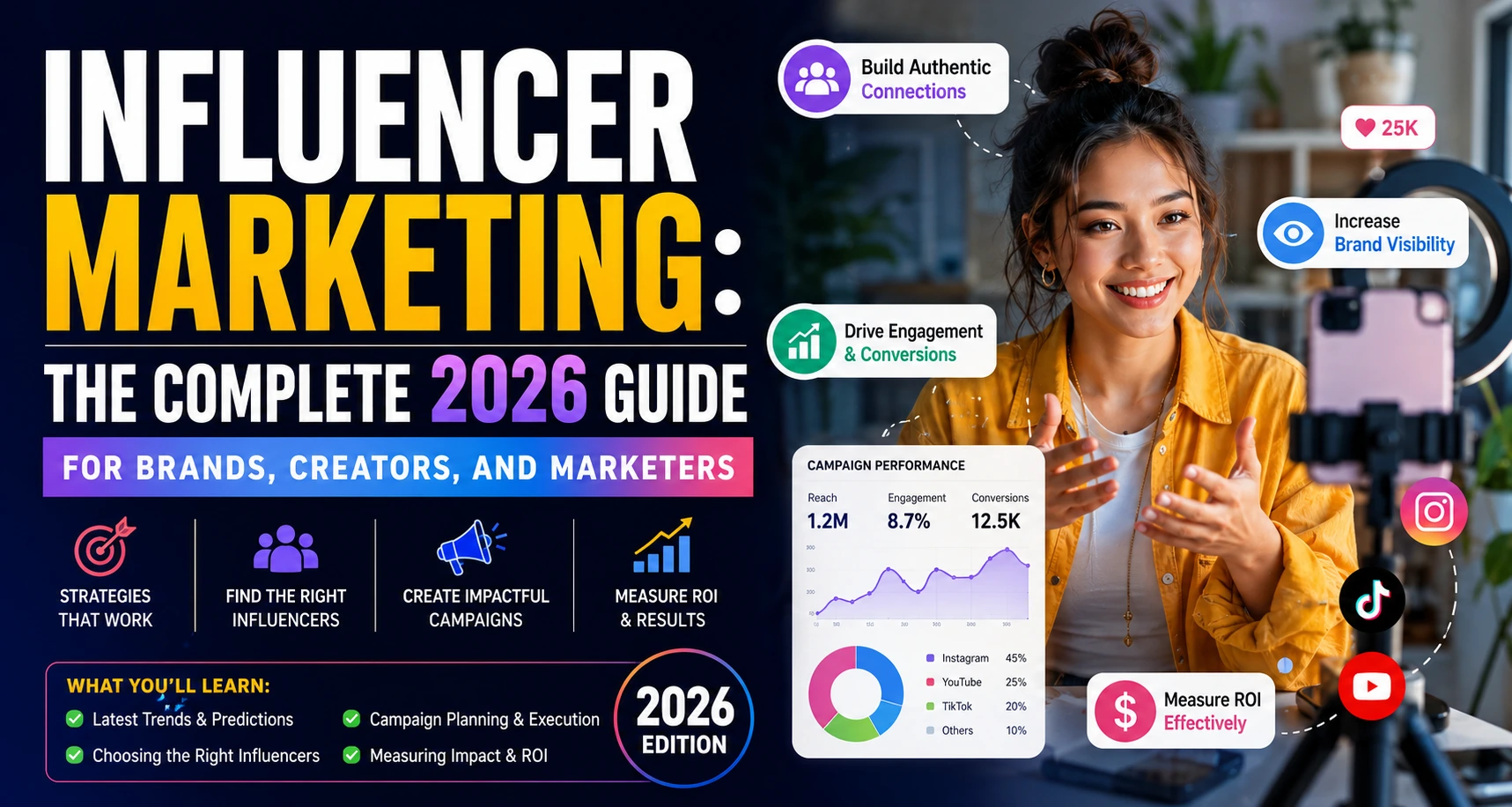
Influencer Marketing: The Complete 2026 Guide for Brands, Creators, and Marketers
Published: May 31, 2026 | Category: Digital Marketing | Reading Time: ~16 minutes
Table of Contents
- What Is Influencer Marketing?
- Influencer Marketing in 2026: Market Size and Key Statistics
- Types of Influencers Every Brand Should Know
- Influencer Marketing Strategies That Actually Deliver ROI
- How to Choose the Right Influencer for Your Brand
- The Best Platforms for Influencer Marketing in 2026
- Influencer Marketing and AI: The New Power Combination
- Measuring Influencer Marketing ROI: Metrics That Matter
- Common Mistakes That Kill Influencer Marketing Campaigns
- The Future of Influencer Marketing
- FAQs About Influencer Marketing
Introduction: Why Influencer Marketing Is Non-Negotiable in 2026
Influencer marketing has crossed every threshold that once defined it as a niche tactic. It is no longer an experiment reserved for consumer brands with Instagram-friendly products. In 2026, influencer marketing is a primary revenue channel for companies across every sector — from fashion and beauty to B2B software, healthcare, financial services, and government communications.
The numbers make the case with no room for debate: the global influencer marketing industry reached $32.55 billion in 2025 and continues to grow at a compound annual growth rate that outpaces most other digital advertising categories. Businesses that embrace influencer marketing earn an average of $5.20 for every $1 spent, making it one of the highest-returning strategies in the entire marketing mix.
If you are a brand manager trying to understand how to structure your first creator program, a founder deciding whether to allocate budget to influencer marketing, or a creator looking to understand how the industry works, this guide covers everything you need — from foundational definitions to advanced strategy, platform selection, ROI measurement, and the future trends reshaping the space right now.
Looking for a Remote Role? Explore 40 Best Websites to Find Remote Jobs in 2026
Discover trusted global platforms, niche job boards, and hidden resources to land your next work-from-anywhere career move.
What Is Influencer Marketing?
Influencer marketing is a strategy in which brands partner with individuals who have established credibility, audience trust, and reach on one or more digital platforms to promote products, services, or messages. Unlike traditional advertising, where a brand speaks directly to a consumer, influencer marketing inserts a trusted human voice between the brand and its target audience.
The “influencer” in this equation can be a celebrity with 50 million followers, a niche fitness coach with 15,000 dedicated subscribers, a YouTube gaming commentator, a LinkedIn thought leader, or a TikTok creator who makes millions of people laugh every morning. What they all share is a relationship with an audience — one built on perceived authenticity, expertise, or entertainment value.
The mechanism works because people trust people. When a fitness influencer recommends a protein supplement, her audience processes that recommendation very differently from how they would process a banner ad. The recommendation carries social proof, personal context, and the implied endorsement of someone they have chosen to follow. That psychological difference is precisely why influencer marketing outperforms traditional advertising channels on virtually every engagement and conversion metric.
At its core, influencer marketing today operates across five broad campaign types:
Sponsored content — the creator publishes a post, video, story, or article that features the brand in exchange for payment or gifted product.
Ambassador programs — a long-term, recurring relationship between a brand and a creator, often with exclusivity clauses and deeper brand integration.
Affiliate partnerships — the creator earns a commission on every sale generated through their unique link or discount code, aligning incentives with actual revenue.
Product seeding — brands send products to creators without a paid agreement, hoping for organic coverage.
Creator-amplified paid media — brands take high-performing influencer content and run it as paid advertising, combining organic credibility with algorithmic reach.
For a foundational overview of how word-of-mouth marketing evolved into modern influencer marketing, the Word of Mouth Marketing Association (WOMMA) offers excellent historical context.
Influencer Marketing in 2026: Market Size and Key Statistics
Understanding the scale and trajectory of influencer marketing in 2026 is essential for making budget decisions and benchmarking your own performance against the industry.
Industry Size and Growth
The global influencer marketing platform market, which covers the software and technology infrastructure supporting campaigns, was valued at $25.44 billion in 2024 and is projected to reach $97.55 billion by 2030, growing at a 23.3% compound annual growth rate. The broader industry — encompassing all brand spend on creator partnerships, content, and distribution — reached $32.55 billion in 2025. The industry has grown 19 times its size since 2016.
Influencer ad spend nearly doubled from 2021 to 2025, and all current projections indicate the growth trajectory will continue through at least the end of this decade.
Consumer Trust and Purchase Behavior
The most compelling data for brands is not about market size — it is about consumer behavior. Consumer trust in influencers climbed to 67% in 2026, up from 61% in 2025. Among Gen Z consumers specifically, 94% trust influencers more than traditional advertisements. Across all age groups, 77% of consumers have made a purchase based on a creator’s recommendation.
These numbers represent a fundamental shift in how purchasing decisions are made in a connected, content-saturated world. Brands that ignore influencer marketing are, in effect, choosing to be absent from the most trusted channel their target customers use when evaluating products.
ROI Benchmarks
According to Influencer Marketing Hub’s 2026 research, brands see an average return of $5.78 for every $1 invested in influencer marketing — a 478% average ROI. This varies meaningfully by vertical:
- Fashion and beauty: 300–600% ROI
- E-commerce (general): 200–500% ROI
- SaaS and B2B software: 150–300% ROI
In 2025, creators on the Aspire platform alone drove over $52 million in attributed affiliate sales, representing 45% year-over-year growth. These are not projections — they are confirmed, measurable revenue outcomes tied directly to creator partnerships.
Cost Efficiency
The average influencer marketing CPM (cost per thousand impressions) across all platforms in 2025 was $2.68, reflecting a 42% year-over-year decrease. This means brands are reaching more people at lower cost than at any previous point in the industry’s history. The declining CPM reflects the maturation and scale of the creator economy — there are more creators, more content, and better targeting tools than ever before.
Types of Influencers Every Brand Should Know
One of the most important decisions in any influencer marketing strategy is selecting the right tier of influencer for your specific goals and budget. The industry classifies influencers by follower count, but follower count is only one dimension of the decision.
Nano-Influencers (1,000–10,000 followers)
Nano-influencers are community-level creators with small but intensely loyal audiences. They often have extremely high engagement rates — sometimes 8–12% compared to the 1–3% typical of larger accounts — because their followers frequently know them personally or follow them around a very specific shared interest. They are highly cost-effective, often willing to collaborate in exchange for product, and represent the most authentic tier of influencer marketing. More than 27% of marketers now work primarily with nano-influencers.
Micro-Influencers (10,000–100,000 followers)
Micro-influencers occupy the sweet spot that most marketing teams have identified as offering the best balance of reach and engagement. They have proven subject-matter expertise, an audience that trusts them specifically on a topic or niche, and rates that remain accessible to brands of many sizes. Another 27% of marketers say micro-influencers are their primary tier. They are particularly effective for product-specific promotions, tutorials, and niche community targeting.
Mid-Tier Influencers (100,000–500,000 followers)
A growing 32% of brands are now investing in mid-tier influencers, drawn by the combination of strong engagement rates (still higher than mega accounts) and meaningful reach numbers. Mid-tier creators often have professional production quality, established content cadences, and a clear audience demographic — all of which make campaign planning more predictable.
Macro-Influencers (500,000–1 million followers)
Macro-influencers deliver scale. They are particularly effective for brand awareness campaigns, new product launches where reach matters more than niche targeting, and situations where a brand wants the credibility that comes with a well-known name in a space.
Mega-Influencers and Celebrities (1 million+ followers)
Mega-influencers — celebrities, mainstream YouTubers, major podcast hosts — provide the broadest possible reach but often come with the lowest engagement rates and the highest costs. They are best deployed for major launches, cultural moments, and campaigns where mass visibility is the primary objective. Their effectiveness varies significantly based on how authentic the brand-influencer fit appears to their audience.
Influencer Marketing Strategies That Actually Deliver ROI
The most common mistake brands make in influencer marketing is treating every campaign as a one-off transaction. The strategies that consistently deliver the strongest returns in 2026 are built around relationships, performance alignment, and compounding content value.
Ambassador Programs: The Highest-ROI Model
Ambassador programs — long-term, recurring partnerships with a select group of creators — delivered the highest ROI of any campaign structure in 2026, according to data from Aspire’s State of Influencer Marketing report. The reason is compounding trust: when an audience sees the same creator talk about a brand repeatedly over months, the endorsement stops feeling like advertising and starts feeling like a genuine lifestyle choice. The creator’s community begins to associate the brand with the creator’s identity.
Setting up ambassador programs requires more upfront investment in vetting, contracting, and onboarding than one-off campaigns. But the compound returns over time — in content quality, audience trust, and measured ROI — consistently outperform transactional approaches.
Affiliate-Based Influencer Programs
Affiliate-based influencer marketing has emerged as one of the fastest-growing campaign structures, reflecting a broader industry shift from pay-to-play to performance-based compensation. In an affiliate model, creators earn a commission on every sale they generate through a unique link or discount code. This aligns the creator’s financial incentives directly with actual revenue outcomes for the brand.
Brands are also gamifying their affiliate programs by offering escalating commission rates as creators hit higher sales milestones — effectively rewarding their best performers and creating a self-reinforcing motivation structure.
Product Seeding at Scale
Product seeding — sending products to creators without a formal paid agreement — accounted for 31% of all campaigns on Aspire in 2025, up from 20% the year before. When done well, product seeding generates authentic unboxing content, honest reviews, and organic endorsements that audiences find far more credible than sponsored posts. The key is targeting creators who genuinely align with the product category, keeping the experience personal, and not attaching strings that would compromise the authenticity of the coverage.
Creator-Amplified Paid Media
One of the most sophisticated strategies available to brands in 2026 is using influencer content as the raw material for paid advertising. When a creator produces a piece of content that performs exceptionally well organically — high saves, shares, comments, and conversion signals — brands can acquire the usage rights and run that content as a paid ad. The result is an advertisement that carries the authenticity and tone of a creator post but has the reach and targeting precision of paid media. Studies consistently show that creator-native content outperforms brand-produced creative in paid campaigns.
How to Choose the Right Influencer for Your Brand
Choosing the wrong influencer is one of the most expensive mistakes a brand can make in influencer marketing. A misaligned partnership wastes budget, produces low-quality content, and can actually damage brand perception. Here is a practical framework for vetting creators before you commit.
Evaluate Audience Alignment, Not Follower Count
The first and most important filter is not how many followers a creator has — it is whether their followers match your target customer profile. A skincare brand partnering with a creator whose audience is primarily teenage gamers has misallocated its budget regardless of how high the follower count looks. Use platform analytics and third-party tools to examine the creator’s audience demographics: age, gender, geography, income level, and interests.
Assess Engagement Quality
Engagement rate is a starting point, but engagement quality is what matters. Look for content where followers leave substantive comments — asking real questions, sharing personal experiences, or seeking specific advice. Generic emoji reactions and one-word comments (“🔥”, “love this!”) are much weaker signals than comments like “I actually tried this and it worked for me” or “Can you do a comparison with brand X?”
Fraud Detection Is Non-Negotiable
The influencer marketing industry has a documented fraud problem. Approximately 37.2% of influencer followers industry-wide show signs of being fake, purchased, or inauthentic. Brands using three-layer verification — AI fraud detection, manual audience auditing, and performance-based payment structures — report 89% lower fraud exposure than brands relying on follower count alone. Never skip the audience quality check before signing a contract.
Verify Brand Value Alignment
An influencer’s content style, tone, values, and past brand partnerships should align naturally with your brand. Audiences are highly attuned to inauthentic partnerships, and a mismatch between an influencer’s usual content and a brand promotion will often generate negative reactions that undermine the campaign before it launches.
For a comprehensive overview of influencer vetting best practices and platform tools, the Federal Trade Commission (FTC)’s guidance on endorsements and testimonials also provides essential legal compliance guidance every brand must follow.
The Best Platforms for Influencer Marketing in 2026
Platform selection is one of the most strategically important decisions in any influencer marketing campaign. Each platform has distinct audience demographics, content formats, engagement norms, and advertiser infrastructure.
Instagram remains the leading platform for influencer marketing, preferred by 57% of brands for their creator campaigns. With over 3 billion monthly active users and a robust ecosystem of Reels, Stories, carousels, and livestreams, Instagram offers unmatched creative versatility. Instagram’s ad revenue is projected at $67.8 billion for 2025, a clear signal that brands are seeing strong commercial value from the platform. It is particularly effective for fashion, beauty, lifestyle, food, travel, and fitness categories.
TikTok
TikTok is the fastest-growing influencer platform and the preferred channel for reaching Gen Z consumers, with 52% of brands now incorporating TikTok into their influencer strategy. The platform’s algorithmic discovery model — which surfaces content to non-followers based on engagement signals — gives even small creators the potential for viral reach that would be impossible on follower-count-driven platforms. Short-form video is the dominant content format in influencer marketing in 2026, and TikTok is its home base.
YouTube
YouTube, preferred by 37% of brands, delivers a fundamentally different value than short-form platforms. Long-form video content on YouTube has a significantly longer half-life than content on Instagram or TikTok. A product review, tutorial, or brand integration on YouTube can generate traffic and conversions for months or years after publication, making it a particularly strong platform for evergreen influencer content. Gaming content (1.24 million posts), sports and fitness (650,000 posts), and fashion (549,000 posts) are the most active categories.
LinkedIn influencer marketing has emerged as the leading channel for B2B brands. Nearly three out of five B2B marketing teams now use an always-on influencer marketing approach, and LinkedIn thought leaders — executives, industry analysts, subject-matter experts — are the primary vehicle. B2B buyers respond to authentic, expert-led content just as strongly as B2C consumers respond to lifestyle creators, and LinkedIn’s professional context makes endorsements from credible voices particularly powerful.
Emerging Channels
Podcast advertising through host-read endorsements remains one of the most trusted forms of creator-based promotion. Newsletters with highly engaged subscriber bases are also increasingly treated as influencer channels, particularly in finance, technology, and professional verticals.
Influencer Marketing and AI: The New Power Combination
Artificial intelligence is reshaping how influencer marketing campaigns are planned, executed, and measured. As of 2026, nearly 9 in 10 marketers are using AI in some capacity for influencer marketing — only 10.56% of practitioners are not using AI at all.
AI-Powered Creator Discovery
Finding the right influencer used to require hours of manual searching, browsing profiles, and cross-referencing audience data. AI-powered platforms now analyze millions of creator profiles, audience demographics, content performance histories, brand affinity signals, and fraud indicators to surface the best-fit creators for a specific campaign objective in minutes. This dramatically reduces the time-to-launch for new campaigns and improves creator-brand alignment.
Content Performance Prediction
AI tools can now analyze early performance signals from an influencer post — the first few hours of engagement patterns, comment sentiment, share rates — and predict the content’s total expected reach and conversion impact. Brands using these tools can make real-time decisions about which creator content to amplify with paid media and which to let run organically.
Campaign Automation and Workflow
Managing dozens or hundreds of simultaneous creator partnerships involves enormous logistical complexity: contracts, deliverable approvals, payment processing, compliance checks, and performance reporting. AI-powered campaign management platforms automate these workflows, allowing marketing teams to manage creator programs at scale without proportionally increasing headcount.
The Authenticity Counterbalance
There is an important counterforce to AI in the creator economy. By 2027, up to 50% of all digital content could be AI-generated, according to Fortune Business Insights. As AI-generated content floods every channel, human-created influencer content will become significantly more valuable precisely because of its authenticity. The strategic implication for brands is clear: use AI for operational efficiency, but invest in genuine human creator relationships for the content itself.
Measuring Influencer Marketing ROI: Metrics That Matter
One of the most persistent challenges in influencer marketing is attribution — connecting creator activity to actual business outcomes. Most brands that struggle to prove ROI are tracking the wrong metrics.
Vanity Metrics vs. Business Metrics
Impressions, reach, and follower counts are visibility indicators, not business indicators. They tell you how many people theoretically saw content, but nothing about whether that exposure changed behavior or generated revenue. Modern influencer marketing measurement focuses on downstream outcomes.
Engagement quality — Are people asking substantive questions? Saving the post? Sharing it with context? Returning to comment again? These signals indicate real audience response, not passive scrolling.
Conversion and attribution — Every influencer campaign should include a trackable mechanism: a unique UTM-tagged link, a custom discount code, or a dedicated landing page. These allow you to tie creator activity directly to website traffic, add-to-cart events, and completed purchases.
Cost per acquisition (CPA) — How much did it cost, total, to acquire one customer through a specific creator partnership? This is the metric that allows you to compare influencer marketing fairly against other acquisition channels like paid search or email.
Lifetime value (LTV) of referred customers — This is the metric most brands overlook and the one that most dramatically favors influencer marketing. Research from SocialLadder indicates that customers referred by creator advocates spend 5.2 times more than regular customers over a 12-month period. When you account for LTV, the ROI of influencer marketing becomes significantly more compelling than first-touch attribution alone suggests.
The Right Measurement Tools
Platform native analytics (Instagram Insights, TikTok Analytics, YouTube Studio) provide post-level performance data but lack cross-platform aggregation and e-commerce attribution. Purpose-built influencer marketing platforms — such as those from Aspire, Impact, and others — layer in affiliate tracking, payment management, and campaign-level ROI dashboards that connect creator activity to CRM and e-commerce data.
For brands building their measurement stack, the Interactive Advertising Bureau (IAB)’s measurement guidelines for influencer marketing provide an industry-standard framework for attribution and reporting.
Common Mistakes That Kill Influencer Marketing Campaigns
Even well-resourced brands with strong influencer marketing ambitions make the same errors repeatedly. Knowing what not to do is as important as knowing what to do.
Chasing follower counts instead of audience fit. A creator with 5 million followers in a demographic that will never buy your product is a waste of budget. A creator with 30,000 followers in your exact target demographic is far more valuable. Always prioritize alignment over scale.
Over-scripting creator content. The single fastest way to produce content that audiences ignore is to hand a creator a rigid script and require verbatim delivery. Influencer audiences follow creators because of their voice, personality, and creative judgment. Brands that give creators the message objective and key product points, then allow creative freedom, consistently produce higher-performing content than brands that dictate every word.
One-off campaign thinking. Single posts rarely build lasting brand association. The brands that win in influencer marketing treat creator relationships as long-term partnerships, building audience familiarity and trust through repeated, consistent exposure over months, not a single sponsored post.
Skipping fraud verification. With over a third of industry followers showing signs of being fake or purchased, entering a paid partnership without a thorough audience quality audit is an avoidable and expensive mistake.
Ignoring FTC disclosure requirements. The Federal Trade Commission requires that any material relationship between a creator and a brand — paid partnerships, gifted products, or any other compensation — be clearly disclosed in the content. Non-compliance exposes both the brand and the creator to legal risk. Ensure every creator you work with understands and follows FTC disclosure guidelines.
Measuring too early. Influencer marketing often operates on a delayed conversion timeline. A consumer who sees an influencer mention a product today may take two weeks to research it, three weeks to add it to their cart, and another week to complete the purchase. Attribution windows that are too short consistently undercount the true ROI of creator partnerships.
The Future of Influencer Marketing
The trajectory of influencer marketing through the remainder of 2026 and into 2027 and beyond is shaped by several converging forces that will fundamentally change how brands and creators collaborate.
Full Performance Accountability
The industry is moving toward complete performance accountability for every creator partnership. Brands will no longer accept campaigns measured in impressions and reach alone. Every creator relationship will be tied to measurable business outcomes — customer acquisition cost, return on ad spend, and revenue generated — applying the same standards used for paid search and email marketing.
The Creator Economy Professionalizes
The creator economy is maturing rapidly. Creators are increasingly operating as professional media businesses: incorporating, hiring team members, negotiating complex contracts, and managing diversified revenue streams across platforms. For brands, this means engaging with more sophisticated counterparties who understand their value and negotiate accordingly. Long-term partnerships with professional creators will replace the informal, ad-hoc engagements that characterized early influencer marketing.
Social Commerce Integration
Social commerce — the ability to complete a purchase directly within a social platform without leaving the app — is becoming a standard feature across Instagram, TikTok, and YouTube. This development collapses the distance between influencer content and purchase completion, dramatically reducing friction in the conversion process. Brands that integrate their influencer partnerships with social commerce capabilities will see measurably higher conversion rates than those running creator content as pure awareness plays.
Live Commerce
Live shopping — influencers conducting real-time product demonstrations and selling events with immediate purchase capability — is among the fastest-growing formats in influencer marketing. Live commerce creates urgency, enables real-time audience interaction, and produces conversion rates that significantly exceed static content. Brands building influencer programs for the next 12–24 months need to include live streaming capabilities as a core creative format, not an afterthought.
Regulation and Transparency
Regulatory oversight of influencer marketing is increasing in the United States and globally. The FTC has already updated its endorsement guidelines, and further enforcement actions are expected as the channel grows. Brands that build compliance and transparency into their creator programs from the start — clear disclosure requirements, documented gifting policies, and careful monitoring of creator claims — will avoid the regulatory exposure that less careful competitors will face.
FAQs About Influencer Marketing
What is the difference between influencer marketing and affiliate marketing? Influencer marketing encompasses any collaboration between a brand and a creator to promote products or services, including paid posts, ambassadorships, and gifting arrangements. Affiliate marketing is a specific compensation model where the creator earns a commission only when a sale is made through their unique link. In 2026, these two categories are increasingly converging, with many influencer programs incorporating affiliate commissions as part of a broader performance-based compensation structure.
How much does influencer marketing cost? Costs vary enormously by influencer tier, platform, content format, and campaign scope. Nano-influencers may collaborate in exchange for gifted product alone. Micro-influencers typically charge between $100 and $2,000 per post. Macro and mega-influencers charge significantly more — often $10,000 to $100,000+ per deliverable. Starting a micro-influencer program with 5–10 creators typically costs between $2,500 and $25,000 in total, making it accessible to small and mid-size businesses.
What is the best influencer tier for small businesses? Micro and nano-influencers are consistently the best starting point for small businesses. They offer high engagement rates, cost-effective partnerships, and niche audience alignment that converts well. The key is finding creators whose audience closely matches your ideal customer, regardless of follower count.
How do I measure whether my influencer marketing campaign worked? Use trackable links, unique discount codes, or dedicated landing pages to connect creator activity to website traffic and sales. Measure cost per acquisition, not just impressions. Track conversion rates and, where possible, the lifetime value of customers acquired through creator referrals. Use your 12-month attribution window before drawing conclusions about ROI.
Is influencer marketing effective for B2B companies? Yes — B2B influencer marketing is one of the fastest-growing segments of the industry. B2B buyers respond to authentic, expert-led content just as strongly as consumers. LinkedIn thought leaders, industry podcast hosts, and niche subject-matter experts are effective B2B influencer partners. Nearly 60% of B2B marketing teams now use an always-on influencer approach.
What platforms are best for influencer marketing in 2026? Instagram (preferred by 57% of brands), TikTok (52%), and YouTube (37%) are the leading platforms. The best platform for your brand depends on where your target audience spends their time and what content format aligns with your product and message.
Final Thoughts: Influencer Marketing Is the Channel of the Decade
Influencer marketing has transformed from a social media side experiment into one of the most measurable, scalable, and trusted channels in modern digital marketing. The brands that treat it as a core revenue channel — rather than a supplementary awareness play — are already seeing compounding returns that traditional advertising simply cannot replicate.
The data is unambiguous: consumers trust creators, they buy based on creator recommendations, and the cost efficiency of influencer marketing relative to traditional paid media continues to improve. A global market of $32.55 billion and growing, an average ROI of 478%, and a consumer trust score of 67% and climbing — these are not the metrics of an emerging trend. They are the metrics of a mature, essential marketing discipline.
Whether your brand is launching its first nano-influencer partnership or scaling a global ambassador program, the principles that drive success remain constant: prioritize authentic audience alignment over vanity metrics, give creators creative freedom, build long-term relationships rather than one-off transactions, measure what actually matters to your business, and stay ahead of the regulatory and technological forces reshaping the landscape.
The brands that master influencer marketing in 2026 will not just win this year’s campaigns — they will build the creator relationships, audience trust, and performance infrastructure that compound into significant competitive advantages for years to come.
Disclaimer: This article is intended for informational and educational purposes only and does not constitute financial, legal, or professional marketing advice. Statistics cited are sourced from publicly available industry research published through May 2026. Always conduct independent due diligence when selecting platforms, creators, and campaign strategies for your specific business context.
Essential Marketing Resources & Guidelines
-
Word of Mouth Marketing Association (WOMMA)