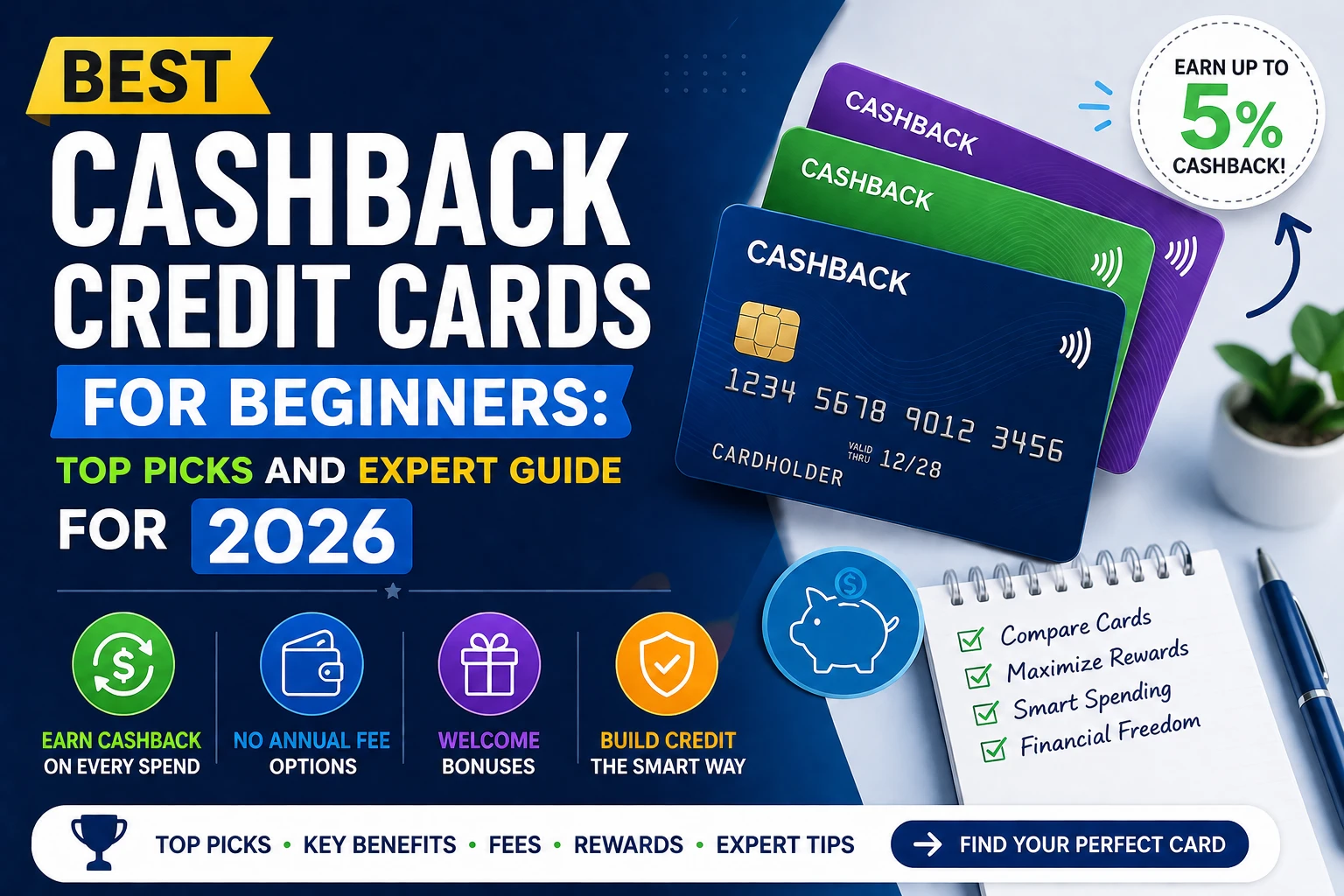
Best Cashback Credit Cards for Beginners: Top Picks and Expert Guide for 2026
Finding the best cashback credit cards for beginners does not have to be complicated, but with hundreds of options on the market in 2026, knowing where to start is half the battle. The right beginner cashback card should be simple to use, carry no annual fee, and reward you for the everyday purchases you are already making — without requiring you to memorize complex category rules or juggle multiple cards at once. This guide cuts straight to the best options available right now, explains how each one works, and walks you through everything you need to know to choose the card that actually fits your spending habits and financial goals.
Best Cashback Credit Cards for Beginners: What to Look for Before You Apply
Before reviewing specific cards, it helps to understand what separates a genuinely beginner-friendly cashback card from the rest of the market. The best cashback credit cards for beginners share a specific set of characteristics that make them easy to use and financially low-risk:
No annual fee. A beginner should never pay an annual fee on their first cashback card. <cite index=”16-1″>Because of their simplicity and cost-effectiveness, no-annual-fee cash-back credit cards can be a good fit for almost anyone — they are highly recommended as beginner cards, but they can continue to find a place in the wallets of even the most experienced credit card users.</cite>
Simple reward structure. Flat-rate cards that pay the same percentage on every purchase are the most beginner-friendly. <cite index=”13-1″>If you are looking for a cash-back card that covers everything, flat-rate cards typically max out at 1.5% or 2% back on every purchase — you might earn a lower rate on some purchases than cards with up to 6% back in specific categories, but you could ultimately come out ahead if your most frequent spending does not fit into typical cash-back categories.</cite>
Accessible approval requirements. Cards designed for beginners typically approve applicants with fair to good credit, not just excellent credit scores.
A meaningful welcome bonus. <cite index=”13-1″>Cash-back credit cards usually offer a cash bonus if you meet a spending threshold within the specified timeframe after opening your account. You will typically see bonuses for $150 to $200 (or more) after spending a minimum of $500 to $2,000 on your card within three to six months of account opening.</cite>
Low APR risk. The best cashback credit cards for beginners are most valuable when paid in full each month. <cite index=”13-1″>Like any credit card, cash-back cards have very high interest rates. You should not opt for a cash-back card if you cannot pay your monthly statement in full, since any revolving balances can quickly turn into high-interest debt.</cite>
Community Intel: See which cashback cards real users on Reddit rank highest for churning, compounding rewards, and avoiding hidden fees.
View Reddit’s Top Cashback CardsBest Cashback Credit Cards for Beginners: 2026 Top Picks Reviewed
Here is a card-by-card breakdown of the best cashback credit cards for beginners available to U.S. consumers right now, based on data from multiple independent analyses published in July 2026.
1. Wells Fargo Active Cash® Card — Best Flat-Rate Card for Beginners
If simplicity is your top priority, no card beats the Wells Fargo Active Cash for a beginner. <cite index=”14-1″>There is a reason the Wells Fargo Active Cash® Card has been the NerdWallet Best-Of Award winner as the best card for simple cash back every year from 2022 to 2026 — every year it has been eligible. The uncapped 2% cash back on every purchase is as good as it gets for a $0-annual-fee card with no membership requirements.</cite>
Key features:
- 2% cash rewards on every purchase, unlimited, with no category tracking required
- $200 cash rewards bonus after spending $500 in the first 3 months
- No annual fee
- 0% intro APR for 15 billing cycles on purchases and qualifying balance transfers (17.49%–27.49% variable APR after that)
- Cell phone protection when you pay your monthly bill with the card
<cite index=”18-1″>The Wells Fargo Active Cash leads for flat-rate simplicity — 2% on everything with no annual fee — making it the ideal pick for simplicity seekers who want maximum return without tracking categories.</cite> The only trade-off is that category-specific cards can earn higher rates in areas like groceries or dining, but for a beginner who does not want to think about their card at checkout, this is the single strongest no-fuss option on the market.
2. Discover it® Cash Back — Best for Maximizing First-Year Earnings
The Discover it Cash Back is one of the most popular best cashback credit cards for beginners precisely because its first-year welcome offer is unlike anything else in the market. <cite index=”11-1″>Discover will automatically match all the cash back you have earned at the end of your first year — there is no minimum spending and no maximum rewards. You could turn $150 cash back into $300.</cite>
Key features:
- 5% cash back on rotating quarterly categories (groceries, restaurants, gas stations, Amazon, and more) up to the quarterly maximum when activated
- 1% cash back on all other purchases
- Unlimited Cashback Match at end of year one — effectively doubling everything you earn
- No annual fee
- 0% intro APR for 15 months on purchases and balance transfers (17.49%–26.49% variable APR after that)
<cite index=”18-1″>Discover’s Cashback Match program doubles all first-year earnings — effectively making this a 10% cash back card on rotating categories and 2% on everything in year one.</cite> The one thing beginners need to be aware of is that the 5% categories rotate quarterly and require activation, which adds a small layer of management. But the first-year Cashback Match makes this one of the highest-value cards available to anyone just starting out with cashback rewards.
3. Chase Freedom Unlimited® — Best for Dining, Travel, and Everyday Spending
The Chase Freedom Unlimited is a standout among the best cashback credit cards for beginners because it combines a solid flat-rate base with elevated rates in popular spending categories — all for no annual fee. <cite index=”11-1″>The card earns 5% cash back on travel purchased through Chase Travel, 3% cash back on drugstore purchases and dining at restaurants including takeout and eligible delivery services, and 1.5% on all other purchases, with no minimum to redeem for cash back.</cite>
Key features:
- 5% on Chase Travel bookings
- 3% on dining and drugstores
- 1.5% on everything else — unlimited, no cap
- $200 sign-up bonus after spending $500 in the first 3 months (in some offers)
- No annual fee
- 0% intro APR for 15 months on purchases and balance transfers
<cite index=”18-1″>The Chase Freedom Unlimited is the best entry point for points optimization beginners — the Chase ecosystem is the most accessible premium travel rewards system.</cite> While the 1.5% base rate falls slightly short of the Wells Fargo Active Cash’s flat 2%, the elevated dining and travel categories make it the smarter pick for beginners who eat out regularly or book travel through Chase.
4. Citi Double Cash® Card — Best for Paying Off Balances While Earning
The Citi Double Cash Card is one of the most mentioned cards across independent 2026 analyses of the best cashback credit cards for beginners, largely because its 2% effective rate is earned in a way that actually incentivizes responsible credit behavior. <cite index=”11-1″>The card earns 2% on every purchase with unlimited 1% cash back when you buy, plus an additional 1% as you pay for those purchases.</cite>
Key features:
- 1% cash back at purchase + 1% cash back when you pay your bill = 2% effective rate
- No annual fee
- No category limits or caps on earning
- Long 0% intro APR offer on balance transfers (terms vary)
- Cash back does not expire as long as the account is open
This structure makes the Citi Double Cash uniquely beginner-friendly in one important sense: it rewards you for paying your bill, which is the single most important habit any new credit card holder can build. The card is especially well-suited to beginners who are also managing some existing debt and want a balance transfer option alongside a solid everyday earning rate.
5. Capital One Quicksilver Cash Rewards Credit Card — Best for Simple Approval
The Capital One Quicksilver is another flat-rate card worth serious consideration among the best cashback credit cards for beginners, particularly for those who are still building their credit history and want a card that is relatively accessible to approve. It earns an unlimited 1.5% cash back on every purchase, carries no annual fee, and comes with a modest welcome offer for new cardholders.
Key features:
- 1.5% unlimited cash back on every purchase
- No annual fee
- 5% cash back on hotels and rental cars booked through Capital One Travel
- One-time cash bonus after meeting an initial spending requirement
- No foreign transaction fees — ideal for beginners who travel internationally
While the 1.5% base rate trails the 2% offered by the Wells Fargo Active Cash and Citi Double Cash, the Quicksilver’s relative accessibility and the lack of foreign transaction fees make it a solid option for students and recent graduates who are building credit from scratch and may not yet qualify for the top-tier flat-rate cards.
6. Bank of America® Customized Cash Rewards Credit Card — Best for Flexible Category Earning
For beginners who want more control over how they earn cashback without paying an annual fee, the Bank of America Customized Cash Rewards card deserves a close look. <cite index=”11-1″>The card lets you pick two everyday bonus categories that fit you best, with 3% cash back on your chosen category and 2% at grocery stores and wholesale clubs.</cite>
Key features:
- 3% cash back on your chosen category (options include gas, online shopping, dining, travel, drug stores, or home improvement)
- 2% at grocery stores and wholesale clubs
- 1% on all other purchases
- $200 cash rewards bonus after spending $1,000 in the first 90 days
- No annual fee
- 0% intro APR for 15 billing cycles on purchases and balance transfers (17.49%–27.49% variable APR after that)
The ability to choose your own top category makes this card genuinely flexible for beginners, since it can be tailored to whichever spending area dominates your monthly budget — whether that is gas for a commuter, online shopping for a college student, or dining for someone in an urban area.
7. Discover it® Secured Credit Card — Best for Beginners with No Credit History
For Americans who are just beginning to establish a credit history and do not yet qualify for the unsecured cards above, the Discover it Secured is widely considered the gold standard among secured cashback cards. <cite index=”12-1″>The card offers ideal features for its category, like no annual fee and automatic reviews for a potential upgrade to an unsecured card. It also earns 2% cash back at gas stations and restaurants on up to $1,000 in combined purchases each quarter, automatically, plus unlimited 1% cash back on all other purchases. The first-year Cashback Match applies here too.</cite>
Key features:
- Requires a refundable security deposit (minimum $200) that becomes your credit line
- No annual fee
- 2% cash back at gas stations and restaurants (quarterly cap), 1% everywhere else
- Unlimited Cashback Match at the end of year one
- Automatic reviews for an upgrade to an unsecured card
- No credit score required to apply
This card is the most direct path for beginners with no credit history to start earning cashback while building the credit profile that will eventually qualify them for unsecured cards with higher earning rates.
How to Choose Among the Best Cashback Credit Cards for Beginners
With seven strong options on the table, the right card for you comes down to three questions:
1. What is your credit score? If you have no credit history at all, start with the Discover it Secured. If you have fair to good credit (roughly 580–700), the Capital One Quicksilver is your most accessible flat-rate option. If you have good to excellent credit (700 and above), the full range of cards above should be available to you.
2. Do you want simplicity or higher category rates? If you never want to think about your card, the Wells Fargo Active Cash or Citi Double Cash delivers a flat 2% on everything without any tracking. If you are willing to pay attention to where you spend most, the Discover it Cash Back’s 5% rotating categories or the Bank of America Customized Cash’s 3% chosen category can earn you significantly more on targeted spending.
3. How important is the first-year bonus? If maximizing earnings in year one is a priority, the Discover it Cash Back’s unlimited Cashback Match is the most valuable welcome structure available at no annual fee — it literally doubles every dollar you earn in the first 12 months. For a straightforward lump-sum bonus, the Wells Fargo Active Cash and Chase Freedom Unlimited both offer $200 after a $500 spending threshold, which is one of the most accessible bonus requirements in the market.
How to Use Cashback Credit Cards as a Beginner: Smart Habits That Matter
Choosing the right card is only half the equation. The other half is using it correctly. Here are the essential habits that determine whether the best cashback credit cards for beginners actually benefit you financially:
Always pay your balance in full every month. This is the single most important rule. Cashback rates of 1.5% to 5% are meaningless if you are carrying a balance at an APR of 20% or higher. The math will always work against you if you revolve a balance. Use the card like a debit card — only spend what you can pay off when the bill comes.
Set up autopay for at least the minimum payment. Even if you plan to pay in full manually each month, setting up autopay for the minimum payment protects your credit score from accidental missed payments due to a forgotten due date.
Use your card for purchases you would make anyway. Do not change your spending behavior to earn more cashback. The reward structure is designed to add value to your existing budget — not to encourage you to spend more.
Track your credit utilization. As a beginner, keeping your credit utilization — the percentage of your available credit you are using — below 30% at any given time is important for maintaining a healthy credit score. Paying down your balance before the statement closing date (not just the due date) helps keep reported utilization low.
Redeem your cashback regularly. Most cards let you redeem cashback as a statement credit, direct deposit, or check. There is no strategic reason to let cashback accumulate for extended periods when you could be applying it to reduce your balance.
Cashback Card Comparison Table: Best Cashback Credit Cards for Beginners at a Glance
| Card | Cash Back Rate | Annual Fee | Welcome Bonus | Best For |
|---|---|---|---|---|
| Wells Fargo Active Cash® | 2% on everything | $0 | $200 after $500 spend | Flat-rate simplicity |
| Discover it® Cash Back | 5% rotating / 1% other | $0 | Cashback Match (year 1) | Maximum first-year earnings |
| Chase Freedom Unlimited® | 5% travel / 3% dining / 1.5% other | $0 | $200 after $500 spend | Dining and everyday spending |
| Citi Double Cash® | 2% effective (1% buy + 1% pay) | $0 | Varies | Debt payoff + earning |
| Capital One Quicksilver | 1.5% on everything | $0 | Cash bonus after threshold | Building credit + travel |
| BofA Customized Cash Rewards | 3% chosen category / 2% grocery | $0 | $200 after $1,000 spend | Flexible category earners |
| Discover it® Secured | 2% gas & dining / 1% other | $0 | Cashback Match (year 1) | No credit history |
Common Mistakes Beginners Make with Cashback Credit Cards
Understanding what to avoid is just as important as knowing which card to pick when evaluating the best cashback credit cards for beginners:
Applying for multiple cards at once. Each credit card application generates a hard inquiry on your credit report. Applying for several cards within a short window can lower your score and signal financial stress to lenders. Start with one card, use it responsibly for six to twelve months, and then evaluate whether adding a second card makes sense.
Choosing a card based on the sign-up bonus alone. A large welcome bonus is only valuable if the card remains useful after you earn it. A $200 bonus with a card that earns just 1% thereafter is often worth less over two or three years than a card with a $0 bonus and a consistently strong earning rate.
Ignoring the APR. Beginners sometimes focus entirely on rewards and overlook the interest rate. If there is any chance you might carry a balance, even occasionally, the APR matters enormously. A 0% intro APR period can be a safety net for large initial purchases — but only if you have a plan to pay down the balance before the promotional period ends.
Forgetting to activate rotating categories. If you choose a card like the Discover it Cash Back with rotating 5% categories, you must activate each quarter’s new categories to earn the higher rate. Missing the activation means you earn only 1% on those purchases, which eliminates much of the card’s advantage.
Closing the card after earning the welcome bonus. Closing a credit card reduces your total available credit, which raises your utilization ratio and shortens your average account age — both of which can hurt your credit score. Keeping your first cashback card open, even if you eventually add others, is generally the smarter long-term move for your credit health.
Frequently Asked Questions About Best Cashback Credit Cards for Beginners
What credit score do I need for the best cashback credit cards for beginners? Most top beginner cards require a good credit score, generally around 670 or above. The Capital One Quicksilver and Discover it Secured are among the most accessible for those with fair credit or no credit history at all.
Is cashback the same as a statement credit? Not exactly, but in most cases the terms are used interchangeably. Most cards let you redeem cashback as a statement credit that directly reduces your balance, though some also offer direct deposit into a bank account or redemption toward gift cards and travel.
Can a beginner get a 2% flat-rate cashback card? Yes. Both the Wells Fargo Active Cash and the Citi Double Cash offer 2% effective cash back with no annual fee, and both are available to applicants with good credit scores — typically 670 and above.
Do cashback rewards expire? It depends on the card. Many cards, including the Discover it and Bank of America cards, explicitly state that cashback does not expire as long as the account remains open. Others may have expiration rules or account closure policies, so checking the terms of your specific card is important.
Should a beginner start with a flat-rate card or a category card? For most beginners, a flat-rate card is the better starting point because it eliminates the complexity of tracking categories. Once you have a year or two of card use under your belt and a clearer picture of your spending patterns, adding a category card to complement your flat-rate card is a natural next step.
Final Thoughts on the Best Cashback Credit Cards for Beginners
The best cashback credit cards for beginners share a clear set of qualities: no annual fee, a simple or flexible reward structure, accessible approval standards, and a welcome bonus that does not require extreme spending to unlock. Based on current 2026 data, the Wells Fargo Active Cash is the top overall pick for simplicity, the Discover it Cash Back delivers the most first-year value thanks to its unlimited Cashback Match, and the Chase Freedom Unlimited is the strongest option for beginners who dine out frequently or want a gateway into the broader Chase rewards ecosystem.
Regardless of which card you choose, the habits you build in your first year matter far more than the specific card in your wallet. Pay in full every month, keep your utilization low, never miss a payment, and let the cashback rewards accumulate as a natural byproduct of your normal spending. Done right, the right beginner cashback card can put anywhere from $200 to $600 back in your pocket in year one — with zero additional spending required.
This article is for informational purposes only and does not constitute financial advice. Credit card terms, rates, and offers are subject to change. Always review the full terms and conditions directly with the card issuer before applying. For further guidance on choosing a credit card, visit the Consumer Financial Protection Bureau, NerdWallet’s credit card comparison tool, or Bankrate’s cash back card hub.