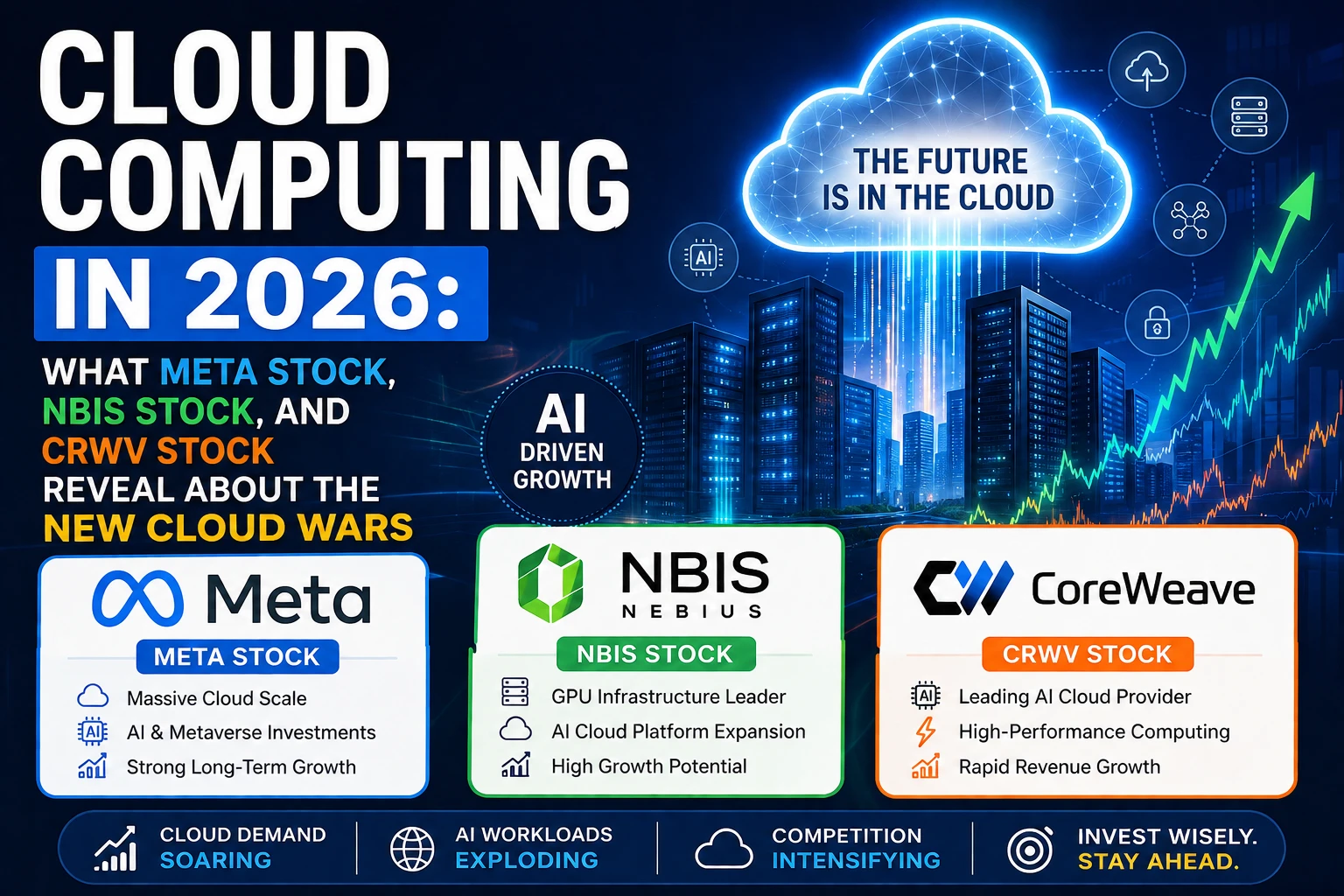
Cloud Computing in 2026: What Meta Stock, NBIS Stock, and CRWV Stock Reveal About the New Cloud Wars
The cloud computing industry just entered one of its most disruptive stretches in years, and three tickers sit at the center of it: Meta stock, NBIS stock, and CRWV stock. In early July 2026, a single report that Meta Platforms is building its own cloud business sent shockwaves through the market, lifting Meta stock by double digits in a single session while dragging down the so-called “neocloud” providers Nebius (NBIS stock) and CoreWeave (CRWV stock). This article breaks down what’s actually happening in the cloud sector right now, how each company fits into the bigger picture, and what investors and tech-industry watchers should understand about where this is heading.
This article is for general informational purposes only. It is not financial advice, and nothing here should be treated as a recommendation to buy or sell any security. Always do your own research and consult a licensed financial advisor before making investment decisions.
Market Insight: SpaceX stock metrics, secondary market valuation, aur valuation changes ki live details dekhein.
SpaceX Stock Price Tracker Check KareinUnderstanding the Cloud Computing Market Today
Before getting into individual stocks, it helps to understand why the cloud has become such a fiercely contested battleground. Cloud computing refers to the practice of delivering computing power, storage, and software over the internet rather than through on-site hardware. Instead of a company buying and maintaining its own servers, it rents capacity from a cloud provider, paying for what it uses. This model has powered some of the most profitable divisions in modern tech, including Amazon Web Services, Microsoft Azure, and Google Cloud, which together dominate the traditional cloud infrastructure market.
The newest and fastest-growing corner of the cloud is built specifically around artificial intelligence workloads. Training and running large AI models requires enormous amounts of specialized computing power, particularly graphics processing units, or GPUs. That demand created an entirely new category of company — often called “neoclouds” — that build data centers packed with GPUs and rent that capacity to AI labs, enterprises, and developers. CoreWeave and Nebius are two of the best-known names in this category, and both have grown at explosive rates as AI demand has surged.
What Is Cloud Computing, and Why Does It Matter So Much Right Now?
The reason the cloud matters so much in 2026 comes down to spending scale. Big technology companies are projected to spend more than $700 billion on AI infrastructure this year alone, roughly 75% higher than what was spent in 2025. That kind of capital outlay only makes sense if the resulting computing capacity gets used — either by the company’s own AI products or by outside customers willing to pay for access. This dynamic is exactly what triggered the latest round of cloud-sector turmoil involving Meta stock, NBIS stock, and CRWV stock.
Cloud infrastructure has become the backbone of the entire AI economy. Every chatbot, image generator, coding assistant, and recommendation engine ultimately runs on cloud computing resources somewhere. As a result, decisions about who builds cloud capacity, who buys it, and who might start selling their own surplus ripple through the stock prices of everyone connected to that supply chain — which is exactly what happened with Meta’s recent announcement.
Meta Stock and the New Cloud Ambitions
Meta stock experienced one of its sharpest single-day moves of the year after Bloomberg reported that Meta Platforms is developing a cloud infrastructure business to sell its excess AI computing capacity to outside customers. Shares jumped roughly 9% to 10%, trading around the $619 level, a dramatic reversal for a stock that had been under sustained pressure, including four consecutive quarterly declines that had wiped out nearly a quarter of its value.
The logic behind the move is straightforward. Meta has dramatically increased its capital spending on data centers, chips, and AI infrastructure, raising its 2026 capital expenditure guidance to a range of roughly $125 billion to $145 billion, up sharply from about $72 billion the year before. That level of investment risks building more computing capacity than Meta’s own apps and AI models can use on a daily basis. Rather than let that capacity sit idle, Meta is reportedly considering renting it out, following a playbook that Amazon used decades ago when internal infrastructure eventually became Amazon Web Services, and one that Elon Musk’s SpaceX has also used more recently by selling excess satellite computing capacity.
At Meta’s annual shareholder meeting, CEO Mark Zuckerberg confirmed that a cloud computing business is genuinely under consideration, noting that other companies regularly approach Meta hoping to purchase spare computing capacity or model access. If Meta formalizes this plan, it would compete directly with Amazon Web Services, Microsoft Azure, and Google Cloud, while also overlapping with the smaller AI-focused neocloud providers.
Wall Street’s initial reaction to Meta stock was largely positive, since a new cloud revenue stream reframes Meta’s enormous infrastructure spending as a potential asset rather than a pure cost center. Analysts have cautioned, however, that cloud services typically carry far thinner margins than Meta’s dominant advertising business, meaning any future cloud revenue may come with a real cost to overall profitability. Meta’s first-quarter 2026 results showed revenue of $56.3 billion, up 33% year over year, with advertising responsible for nearly all of that growth, underscoring just how central ads still are to the company’s financial engine.
What Is Meta?
For readers less familiar with the company, Meta Platforms is the parent company of Facebook, Instagram, WhatsApp, and Messenger, along with its growing artificial intelligence and virtual reality divisions, including Meta AI and the Reality Labs unit. Meta has poured enormous resources into AI development in recent years, including a highly publicized effort to build out Meta Superintelligence Labs and a reported $14 billion investment to bring in AI leadership from outside the company. Its core business, however, remains overwhelmingly advertising, generated primarily through Facebook and Instagram. The idea of Meta entering the cloud computing market represents a meaningful strategic shift, since it would mark Meta’s first serious attempt at building a business-to-business infrastructure product rather than a consumer-facing app or advertising platform.
NBIS Stock: Nebius and the AI Cloud Boom
NBIS stock refers to Nebius Group, a Netherlands-based technology company that builds full-stack infrastructure for the global AI industry, including large-scale GPU clusters and cloud platforms for developers. Nebius has positioned itself as one of the fastest-growing neocloud providers, with first-quarter 2026 group revenue rising an extraordinary 684% year over year to $399 million, and its annualized run-rate revenue climbing to $1.9 billion from $1.25 billion just one quarter earlier.
Nebius has attracted significant outside investment to fund its rapid buildout, ending its most recent quarter with $9.3 billion in cash after raising $6.3 billion during the period, including a $2 billion investment from Nvidia. The company has also secured a major agreement with Meta reportedly worth up to $27 billion, which is precisely why NBIS stock reacted so sharply to news of Meta’s potential entry into the cloud market. If one of Nebius’s largest customers becomes a direct competitor, some of that future business could be at risk.
When the Meta cloud report broke, NBIS stock fell sharply, dropping roughly 6% to nearly 17% depending on the trading session, at one point sinking to around $229 per share, well below its 52-week high near $300. Despite the pullback, some analysts still view Nebius favorably given its rapid growth and expanding margins, while others have flagged its relatively high valuation, trading at a much steeper multiple of forward revenue compared to peers like CoreWeave.
CRWV Stock: CoreWeave’s Role in the Cloud Infrastructure Race
CRWV stock represents CoreWeave, a cloud infrastructure company built specifically around GPU-accelerated computing for artificial intelligence workloads. CoreWeave offers what it calls the CoreWeave Cloud Platform, along with data and storage tools, infrastructure management software, and AI development products following its acquisition of Weights & Biases. Like Nebius, CoreWeave has grown rapidly by supplying the GPU capacity that AI labs and enterprises need for training and running large models, and it has signed sizable agreements with major technology companies, including a disclosed $21 billion commitment from Meta.
That deep relationship with Meta is exactly why CRWV stock fell hard on news of Meta’s cloud ambitions, sliding around 14% in a single session to roughly $85 to $86 per share, extending a broader pullback that has left the stock down nearly 48% from its 52-week high of about $166. CoreWeave’s financial profile highlights both the promise and the risk baked into the neocloud business model: its first-quarter net loss widened to $740 million, total debt reached nearly $25 billion, and interest expense alone consumed close to half of its adjusted earnings before interest, taxes, depreciation, and amortization.
Even so, CoreWeave continues to guide for substantial growth, targeting $3 billion to $3.4 billion in revenue for 2026 and a year-end run rate between $7 billion and $9 billion. Some analysts have argued the sell-off in CRWV stock was overdone, pointing to CoreWeave’s lower valuation relative to sales compared to Nebius, even though that lower multiple comes paired with significantly higher debt levels.
How the Cloud Wars Are Reshaping Meta Stock, NBIS Stock, and CRWV Stock
Taken together, the moves in Meta stock, NBIS stock, and CRWV stock illustrate a structural risk that’s becoming impossible to ignore across the cloud sector: the same hyperscale technology companies funding the AI boom are also among the biggest customers of the specialized cloud providers built to serve that boom. When a customer the size of Meta considers becoming a competitor, it introduces genuine uncertainty about future contract renewals, pricing power, and long-term demand for neocloud providers like CoreWeave and Nebius.
At the same time, this shake-up doesn’t necessarily spell doom for the smaller cloud players. Meta’s cloud ambitions remain unconfirmed and, according to reporting, still early in development, with the company reportedly still debating whether to sell raw computing capacity, hosted AI model access, or some combination of both. Analysts have also pointed out that Meta is unlikely to challenge the established hyperscalers like Amazon Web Services, Microsoft Azure, and Google Cloud directly, and may instead compete more narrowly with neocloud-style providers in specific AI workloads. That distinction matters for how much of CoreWeave’s and Nebius’s addressable market genuinely overlaps with what Meta might offer.
It’s also worth noting that other neocloud-adjacent companies, including data center operators like IREN and Applied Digital, saw their shares affected by the same news, suggesting the market is treating this as a sector-wide competitive shift rather than a one-off event isolated to Meta stock, NBIS stock, and CRWV stock alone.
Risks and Opportunities in the Cloud Computing Sector
For anyone following the cloud sector, a few themes stand out as particularly important going forward:
Customer concentration risk. Both CoreWeave and Nebius depend heavily on a small number of large technology companies for a significant share of their revenue. When one of those customers, such as Meta, considers building competing infrastructure, it exposes just how much these neocloud providers rely on continued goodwill and contract renewals from a handful of giants.
Margin pressure versus growth potential. Cloud infrastructure, especially the AI-focused variety, requires enormous ongoing capital investment in data centers, chips, and power. Companies pursuing this strategy, including Meta, CoreWeave, and Nebius, face a persistent tension between funding rapid growth and managing debt, interest expense, and thinner margins compared to software or advertising businesses.
Unconfirmed plans versus confirmed spending. It’s worth remembering that Meta’s cloud business, as of this writing, remains a reported plan rather than a formally announced product. Meanwhile, the capital expenditure figures behind it, including Meta’s raised 2026 guidance, are already locked in and disclosed. Investors should weigh confirmed financial commitments more heavily than speculative business lines that could still change shape or get shelved entirely.
Broader industry validation. Regardless of how Meta’s specific plans play out, the episode reinforces just how central cloud infrastructure has become to the entire technology sector’s growth story. Even a company as dominant in advertising as Meta is exploring cloud computing as a strategic hedge, which speaks to how valuable and durable the underlying demand for AI computing power has become.
How the Cloud Industry Got Here
To fully appreciate why Meta stock, NBIS stock, and CRWV stock are reacting so violently to a single strategic report, it helps to understand how the cloud computing industry evolved into its current shape. Cloud computing as a mainstream business model traces back to the mid-2000s, when Amazon began offering outside developers access to internal computing infrastructure it had originally built to run its own retail operations. That experiment eventually became Amazon Web Services, now one of the most profitable divisions inside Amazon and a template that other technology giants would later follow with Microsoft Azure and Google Cloud.
For roughly a decade and a half, those three companies dominated the cloud landscape with broad, general-purpose infrastructure serving everything from small startups to Fortune 500 enterprises. The generative AI boom changed the calculus. Training large language models and running AI inference at scale requires specialized hardware, primarily GPUs, at a volume and configuration that differs meaningfully from traditional cloud workloads. That gap created room for a new wave of AI-focused cloud providers, including CoreWeave and Nebius, both of which built their businesses specifically around supplying GPU capacity to AI labs and enterprises that needed more specialized infrastructure than the traditional hyperscalers could easily provide.
Meta’s reported cloud ambitions represent a potential third wave: a company that built massive AI infrastructure purely for its own internal use now considering whether to open some of that capacity to outside customers, much like Amazon did with its retail infrastructure two decades earlier. Whether that comparison holds up in practice remains an open question, since Amazon’s cloud business grew out of a deliberate, methodical internal engineering effort, while Meta’s situation appears to be driven more by the practical reality of having built more AI capacity than it currently needs.
Why This Matters Beyond Meta Stock, NBIS Stock, and CRWV Stock
While Meta stock, NBIS stock, and CRWV stock have captured headlines because of their direct involvement in this story, the implications extend further across the technology sector. Chipmakers like Nvidia and AMD depend heavily on continued cloud infrastructure spending, since GPUs are the core hardware that powers both hyperscaler and neocloud data centers alike. Enterprise software companies that build AI-powered products also depend on affordable, available cloud computing capacity to run their applications, meaning shifts in cloud pricing or supply can ripple into unrelated corners of the market.
There’s also a broader competitive dynamic worth watching: if large, cash-rich technology companies increasingly decide to monetize their own excess AI infrastructure rather than solely renting from neocloud providers, it could gradually consolidate more of the cloud computing market around a smaller number of vertically integrated players. That would represent a meaningful shift from the current landscape, where specialized providers like CoreWeave and Nebius have carved out a distinct niche by focusing exclusively on AI infrastructure rather than the broader, more general-purpose cloud services offered by Amazon, Microsoft, and Google.
Frequently Asked Questions About Cloud Computing, Meta Stock, NBIS Stock, and CRWV Stock
Is Meta actually launching a cloud business? As of the most recent reporting, Meta has not formally confirmed the plan. Bloomberg reported that Meta is developing a cloud infrastructure business, and Meta’s own CEO has acknowledged the idea is under serious consideration, but the company has not made an official announcement or released product details.
Why did NBIS stock and CRWV stock fall on news about Meta stock? Both Nebius and CoreWeave count Meta as one of their largest customers, with multibillion-dollar infrastructure agreements already in place. Investors reacted to the possibility that Meta could eventually need less outside cloud capacity if it builds and sells its own, which would directly affect future revenue for both neocloud providers.
What is the difference between CRWV stock and NBIS stock? CoreWeave (CRWV stock) is generally considered the larger, more established neocloud provider, with lower valuation multiples relative to revenue but significantly higher debt levels and net losses. Nebius (NBIS stock) is smaller but has posted extremely rapid revenue growth and holds a larger cash position, though it trades at a steeper valuation relative to current sales.
Does Meta’s potential entry into cloud computing threaten Amazon, Microsoft, and Google? Most analysts view this as unlikely in the near term. Meta’s reported plans appear more narrowly focused on selling AI-specific computing capacity, positioning it closer to a neocloud competitor than a direct challenger to the broader, more diversified cloud businesses run by Amazon Web Services, Microsoft Azure, and Google Cloud.
Should I buy Meta stock, NBIS stock, or CRWV stock based on this news? That decision depends on individual financial goals, risk tolerance, and research, and this article isn’t intended to make that call for you. All three stocks have shown significant volatility recently, and cloud infrastructure investments carry real risks tied to capital spending, debt, and customer concentration. Speaking with a licensed financial advisor and reviewing each company’s official financial disclosures is the appropriate next step before making any investment decision.
Final Thoughts on the Future of Cloud Computing
The cloud sector is going through a genuine structural shift as AI demand reshapes who builds infrastructure, who buys it, and who might eventually compete for the same customers. Meta stock’s sharp rally reflects investor enthusiasm about turning enormous AI spending into a new revenue stream, while the declines in NBIS stock and CRWV stock highlight just how exposed specialized cloud providers are to decisions made by their biggest customers. None of this happens in isolation — it’s part of a broader, industry-wide race to build, monetize, and defend cloud computing capacity as AI adoption accelerates. Whether Meta’s cloud ambitions become a fully realized business or remain an unconfirmed plan, the episode is a clear signal that cloud infrastructure, and the companies that build it, will remain one of the most closely watched corners of the market for the foreseeable future.
For further reading on this story, see the original reporting from Bloomberg and additional coverage from CNBC.