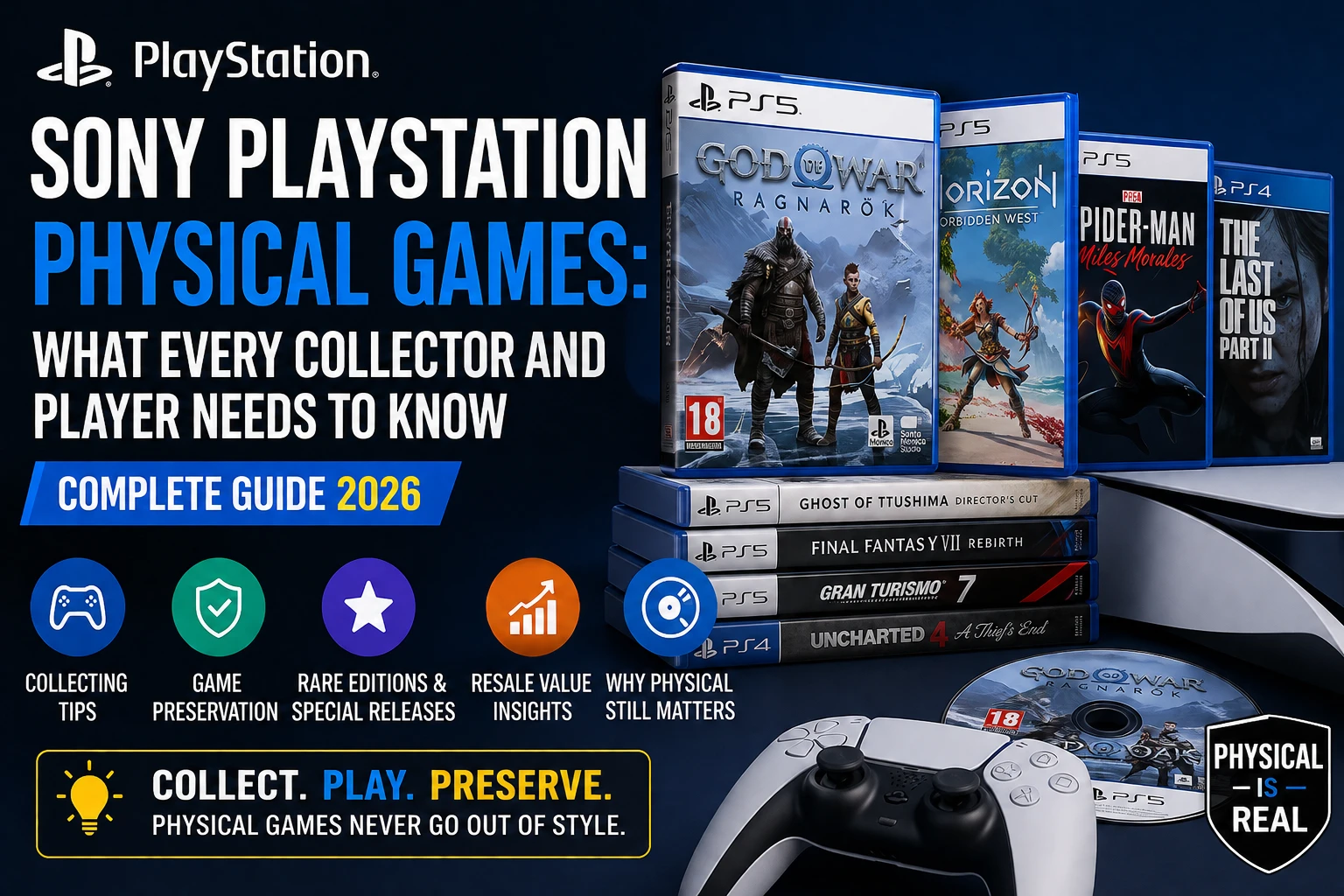
Sony PlayStation Physical Games: What Every Collector and Player Needs to Know Right Now
Sony PlayStation physical games are entering one of the biggest transitions in the platform’s history, and if you own a disc collection, a PS3, or a PS Vita, the next 18 months will directly affect how you buy, download, and preserve your library. Sony has just confirmed two major changes at once: the shutdown of the PlayStation Store on older hardware, and the end of physical disc production for new releases. This guide breaks down exactly what’s happening, when it happens, and what steps you should take today to protect the games you already own.
Gaming Update: PS Plus June 2026 ke confirmed free titles, expansions, aur gameplay drops ki poori list check karein.
PS Plus June Games Tracker DekheinUnderstanding Sony PlayStation Physical Games Today
For nearly three decades, Sony PlayStation physical games have been a core part of how American gamers built their libraries — buying a disc at a retail store, lending it to a friend, or reselling it once finished. That model is now shrinking fast. Sony has announced it will stop producing new physical discs starting January 2028, a change confirmed directly through the official PlayStation Blog. According to the announcement, physical game disc production for all new games releasing on PlayStation consoles will be discontinued starting January 2028, after which new titles will be sold only in digital formats through the PlayStation Store and at retailers.
Importantly, this shift does not erase the discs already on your shelf. Sony has been explicit that the change applies only going forward: the transition has no impact on games that already released, or will be releasing, prior to January 2028 in disc format. In other words, your existing Sony PlayStation physical games collection remains playable and valid — it’s new releases after the cutoff that will skip discs entirely.
What Is Sony PlayStation?
Before diving deeper into the changes, it helps to be clear about the terminology. Sony PlayStation refers to the entire family of gaming consoles, handhelds, and digital services owned by Sony Interactive Entertainment, spanning the original PlayStation, PS2, PS3, PS4, PS5, PSP, and PS Vita, along with the PlayStation Store, PlayStation Plus subscription service, and PlayStation Network. Sony PlayStation has historically supported both physical and digital game distribution side by side, letting players choose based on preference, price, or resale value. The recent announcements mark the clearest signal yet that Sony PlayStation is steering that balance firmly toward digital-first distribution, following a broader pattern already seen in movies, television, and music.
The PlayStation Store PS3 PS Vita Closure Explained
Alongside the disc announcement, Sony also confirmed the long-rumored PlayStation Store PS3 PS Vita closure, a decision that reverses an earlier reversal. Back in 2021, Sony first announced plans to shut down these same stores, only to back down within weeks after intense fan pushback. This time, the company says the closure is final. In a post from Sid Shuman, Senior Director of Sony Interactive Entertainment Content Communications, Sony explained that PS3 and PS Vita are no longer able to support updated payment processing standards at the level required for the store to keep functioning securely.
The PlayStation Store PS3 PS Vita closure is rolling out in stages rather than all at once:
- Mexico, Honduras, and Nicaragua — the PS3 store closes starting August 2026
- Additional Latin American and Middle Eastern markets — closing starting late 2026
- All other countries, including the United States — both the PS3 and PS Vita stores close in July 2027
Once a region’s deadline passes, new purchases become impossible on that device, though Sony says players will still be able to download previously purchased content after the closing date for the foreseeable future. That distinction matters: you won’t lose access to games you already bought, but the shopping window for anything new on PS3 or PS Vita is closing for good.
Why Sony Physical Games Are Being Phased Out
Sony has framed the move away from Sony physical games as a response to how people already play, not a sudden strategic pivot. In its blog announcement, the company described the change as a natural direction for Sony Interactive Entertainment to adapt to consumer trends as the general preference for digital media significantly outpaces physical discs. That mirrors what happened years earlier in the film, television, and music industries, where streaming and downloads gradually replaced DVDs, CDs, and physical rentals.
There’s also a practical, industry-wide backdrop to this decision. Reporting on the announcement noted that the change follows Take-Two Interactive’s decision to price physical editions of a major upcoming release without a disc inside the box, relying instead on a download code. When even blockbuster, highly anticipated titles start shipping without a physical disc, it signals that publishers across the industry are recalibrating how much shelf space and manufacturing investment physical media still deserves.
It’s worth noting what this change does not do. Sony has been clear that retail stores won’t disappear entirely — physical packaging will likely continue in some form, such as boxes containing download codes rather than discs, similar to how some PC games have shipped for years. What changes is the disc itself, the small piece of physical media that has defined “owning” a game since the PS1 era.
Timeline: How Sony Physical Games Are Changing Through 2028
To keep the moving pieces straight, here’s a consolidated timeline covering both announcements:
| Date | What Happens |
|---|---|
| August 2026 | PlayStation Store closes on PS3 in Mexico, Honduras, and Nicaragua |
| Late 2026 | PlayStation Store closes on PS3 in additional Latin American and Middle Eastern markets |
| July 2027 | PlayStation Store closes on PS3 and PS Vita in all remaining countries, including the US |
| January 2028 | Physical disc production ends for all new PlayStation game releases |
Games released before January 2028 are unaffected and will continue to be sold on disc through their normal retail life cycle. The cutoff applies specifically to new titles launching after that date, not a retroactive removal of existing physical stock.
What This Means for Your Existing Sony PlayStation Physical Games
If you already own a shelf of Sony PlayStation physical games, very little changes for you in practical terms. Discs you own will keep working in your console for as long as the hardware itself functions — this announcement affects future production and new digital storefront access, not the discs currently in your home. That said, a few real consequences are worth planning around:
Buying new PS3 or Vita content gets harder over time. Once your region’s PlayStation Store PS3 PS Vita closure date passes, you can no longer purchase new digital add-ons, expansions, or digital-only titles for those systems. If there’s a PS Vita or PS3 digital game you’ve been meaning to grab, doing so before your region’s deadline is the safer move.
Redownloading previously purchased content should remain possible. Sony has stated that previously bought content stays downloadable after the store closes, similar to how Nintendo handled the 3DS eShop closure. Even so, it’s smart to download anything important to your own console storage now, rather than counting on redownload access indefinitely.
Physical discs remain the more durable option for preservation. Ironically, the shift away from new physical media makes the discs already in circulation more valuable to collectors and preservationists, since they don’t depend on a server staying online. Sony PlayStation physical games purchased on disc will still work with no internet connection required, unlike digital libraries tied to an account and an active storefront.
Resale and secondhand markets may shift. As physical production winds down after 2028, existing sealed and used copies of Sony physical games could become more sought-after among collectors, similar to trends seen with older Nintendo and Sega cartridges after their production runs ended.
How to Protect Your PlayStation Games Collection
Whether you’re a casual player or a longtime collector, a few simple steps now will save headaches later as these changes take effect:
- Check your region’s PlayStation Store PS3 PS Vita closure date. Confirm whether you fall into the August 2026, late 2026, or July 2027 window so you know your real deadline for new purchases.
- Buy any digital-only PS3 or Vita titles you still want. Focus especially on games that never received a physical release or remaster elsewhere, since those become far harder to obtain once the store closes.
- Download everything you’ve already purchased. Pull existing digital purchases onto your console’s local storage rather than relying on the store staying available for future redownloads.
- Back up save data. Copy save files to an external drive or supported cloud storage so your progress isn’t tied to a single piece of aging hardware.
- Hold onto physical discs carefully. With new disc production ending in 2028, existing Sony PlayStation physical games are the most future-proof way to keep a title playable without depending on any online service.
- Watch how retailers adapt after 2028. Expect physical store shelves to gradually shift toward boxed download codes rather than pressed discs, a transition already underway for some major upcoming releases.
A Brief History of Sony PlayStation and Physical Media
To understand why this moment feels significant, it helps to look back at how central physical media has been to Sony PlayStation since the very beginning. The original PlayStation launched in the mid-1990s and helped popularize the CD-ROM as a gaming format, offering more storage and cheaper manufacturing than the cartridges used by competitors at the time. The PS2, PS3, and PS4 generations carried that format forward onto DVD and Blu-ray discs, with physical retail sales remaining a dominant revenue channel well into the 2010s.
Digital distribution began chipping away at that dominance gradually rather than suddenly. The PlayStation Store launched in the mid-2000s, giving players a second way to buy Sony PlayStation physical games’ digital counterparts without leaving the couch. Over time, day-one digital releases, pre-order bonuses tied to digital purchases, and expanding broadband access shifted more of the audience toward downloads. By the PS5 era, Sony itself sold both a disc-equipped model and an all-digital model side by side, effectively testing consumer appetite for a discless future years before this announcement.
Seen in that context, the move to end new physical disc production in 2028 isn’t a sudden reversal — it’s the logical endpoint of a shift that’s been building for close to two decades. What makes this moment different is the finality: unlike earlier signals, this is a firm date on the calendar, not a slow fade.
How This Compares to Other Gaming Platforms
Sony isn’t moving in isolation. Reporting on the disc production announcement noted that Microsoft’s Xbox division has also been testing features that let players convert existing physical game collections into digital licenses, suggesting the entire console industry is nudging toward a similar destination. Nintendo, meanwhile, has taken a more mixed approach, continuing physical cartridge production for its Switch platform while still supporting a robust digital storefront alongside it.
What sets the Sony PlayStation announcement apart is its scope and specificity. Rather than a vague statement about “industry trends,” Sony attached an exact date, January 2028, and confirmed the change applies to every new PlayStation game going forward, regardless of publisher. That level of clarity gives retailers, developers, and collectors a firm planning horizon that’s been missing from similar conversations about the future of physical media in gaming.
What Retailers and Publishers Are Already Doing
The shift away from Sony physical games isn’t only visible in Sony’s own announcements — it’s already showing up in how individual publishers plan their releases. One of the most closely watched examples involves a major upcoming open-world title from Take-Two Interactive, which is reportedly pricing its physical retail edition without an actual disc inside the case, opting instead for a printed download code. That decision, made independently of Sony’s announcement but arriving around the same time, illustrates how publishers are already adjusting their physical packaging strategy even before Sony’s 2028 cutoff takes effect industry-wide.
For retailers like GameStop, Best Buy, and Walmart, this transition likely means a gradual shift in how PlayStation games occupy shelf space. Expect boxed products to increasingly function as a physical representation of a digital purchase — a case, some artwork, maybe a code card — rather than a container for a functional disc. This mirrors packaging trends already common in PC gaming, where boxed retail copies have included download codes for years, particularly for larger open-world titles distributed primarily through digital storefronts like Steam.
Game Preservation and Community Reaction
News of the PlayStation Store PS3 PS Vita closure has reignited a long-running conversation about game preservation. Both platforms host a meaningful number of titles that were never rereleased on later hardware or remastered for PS4 and PS5, meaning some digital-only games risk becoming difficult to legally obtain once their storefronts close. Preservationists and enthusiast communities have pointed out that PS3 and PS Vita still remain, for now, the only official digital storefronts offering certain older or niche titles that publishers never brought forward to modern platforms.
This is part of why gaming historians and archivists tend to react to storefront closures with more urgency than casual players. A disc on a shelf will likely still boot up on original hardware decades from now, but a digital license tied to an aging online store has a much shorter guaranteed lifespan. That contrast is fueling renewed interest in physical preservation efforts, fan-run archives, and advocacy groups that push publishers to keep older catalogs accessible even after official storefronts shut down.
The response from longtime PlayStation fans has been a mix of resignation and nostalgia rather than the intense backlash that followed the original 2021 announcement. Many players have noted that, unlike five years ago, this closure comes with a longer runway and clearer communication, giving people more time to plan ahead. Still, there’s a shared sense among longtime PlayStation owners that this marks a genuine changing of the guard, closing out consoles that, in the PS3’s case, first launched nearly two decades ago and helped define an entire era of console gaming.
Frequently Asked Questions About Sony PlayStation Physical Games
Will my current Sony PlayStation physical games stop working? No. Physical discs you already own will keep working in compatible hardware indefinitely. These announcements affect new disc production and older digital storefronts, not the functionality of games you already own.
Is this the same closure Sony announced in 2021? It’s a repeat of the same plan, not a continuation of it. Sony originally announced the PlayStation Store PS3 PS Vita closure in 2021 before reversing course within weeks after fan backlash. This new announcement confirms the closure is happening on a revised, longer timeline.
Can I still buy PS3 or PS Vita games after the store closes? Only secondhand or through remaining physical retail stock, if any exists. Once your region’s closure date passes, new digital purchases through the PlayStation Store are no longer possible on those devices.
Does the disc production shutdown affect PS4 or PS5 games already on shelves? No. Sony has confirmed that games releasing before January 2028 are unaffected, so existing PS4 and PS5 physical titles remain exactly as they are. The change applies to new game releases launching after that date.
Are all PlayStation games going fully digital? Not immediately, and not entirely. New physical disc production stops in January 2028, but Sony has indicated that some form of retail packaging, potentially with download codes rather than discs, may continue. Digital purchases through the PlayStation Store will remain available across current and future PlayStation games regardless of format changes to physical media.
Why is Sony making this change now? Sony has pointed to two overlapping factors: outdated payment infrastructure on PS3 and PS Vita that can no longer meet current security and processing standards, and a broader consumer shift toward digital purchases that has made physical disc manufacturing less central to how PlayStation games are sold and played.
Final Thoughts on the Future of Sony PlayStation Physical Games
The next two years mark a genuine turning point for Sony PlayStation physical games, closing out an era that began with the original PlayStation disc format nearly thirty years ago. The PlayStation Store PS3 PS Vita closure removes new purchasing options from two beloved older systems, while the 2028 disc production cutoff signals where the platform is headed for every future release. Neither change erases the value of the physical library already sitting on shelves across the country — if anything, it raises the importance of downloading, backing up, and holding onto what you already own. For players who have grown up buying PlayStation games on disc, the smartest move right now is simple: check your region’s timeline, secure the digital titles you still want, and treat your existing physical collection as the lasting, offline-friendly asset it’s about to become.
Looking further ahead, it’s worth watching how Sony handles future hardware in light of these decisions. Whether an eventual next-generation console still includes a disc drive at all remains an open question, and one that will likely shape how much of a role Sony physical games continue to play beyond this current transition period. For now, though, nothing about your existing library needs to change. The discs in your collection will keep working, your PS5 and PS4 games remain unaffected, and the practical urgency is limited to two clear actions: using your region’s PlayStation Store PS3 PS Vita closure window to grab anything digital-only you still want, and making sure your existing purchases and save data are backed up well before any deadline arrives.
For the full official details, read Sony’s original announcements directly on the PlayStation Blog closure notice and the PlayStation Blog disc production announcement.