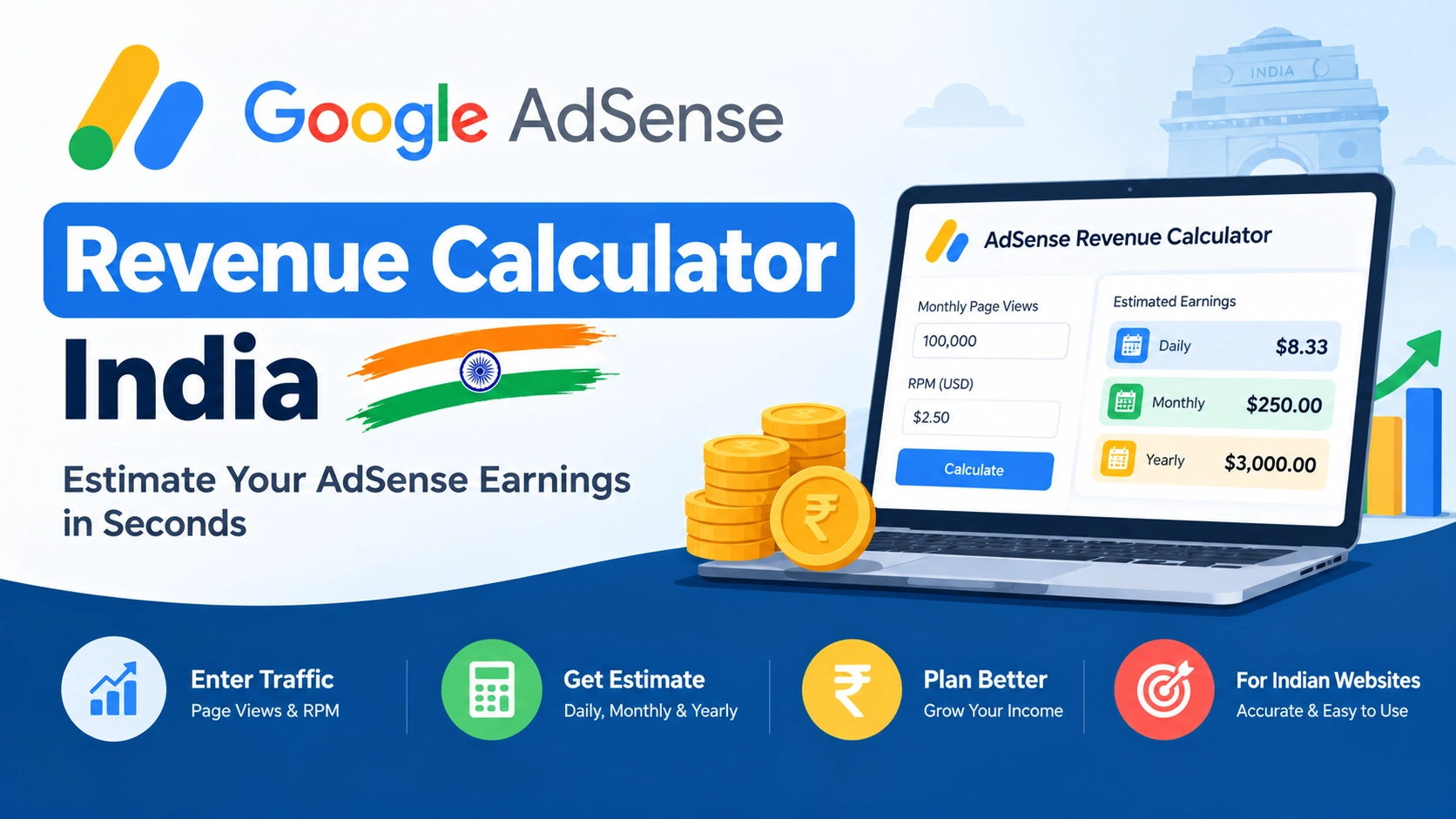
Google AdSense Revenue Calculator India
Quick Overview
The Google AdSense Revenue Calculator India helps website owners estimate potential AdSense earnings based on daily page views, click-through rate (CTR), cost per click (CPC), and Page RPM. By entering your traffic and monetization details, you can get an estimated view of your potential daily, monthly, and yearly AdSense income. The calculator also supports country-based benchmarks, including India, so publishers can compare different earning scenarios and better understand how traffic and ad performance can influence website revenue.
What Is a Google AdSense Revenue Calculator?
A Google AdSense Revenue Calculator is a simple estimation tool that helps publishers understand how website traffic could translate into advertising income.
Instead of using a fixed amount for every 1,000 visitors, the calculator considers important advertising metrics such as:
The calculator provides two different calculation methods. You can estimate revenue using CTR and CPC, or use Page RPM when you already know your approximate revenue per 1,000 page views.
This makes the tool useful for bloggers, publishers, niche website owners, and content creators who want to estimate potential AdSense income.
How Does the AdSense Calculator Work?
The calculator uses two main methods to estimate advertising revenue.
CTR and CPC Method
The first method calculates potential earnings from page views, CTR, and CPC. The formula is:
For example, suppose an Indian website receives 10,000 page views per day, has a 1.1% CTR, and an average CPC of ₹0.08.
This demonstrates how traffic, CTR, and CPC work together to produce an estimated revenue figure. The calculator performs these calculations automatically when you enter your page views, CTR, and CPC.
Page RPM Method
The second option uses Page RPM. The formula is:
For example, if a website receives 10,000 daily page views and has a Page RPM of ₹80:
This method is especially useful when you already have historical RPM information from your AdSense performance data. The calculator applies the RPM formula directly to your daily page views.
AdSense Earnings Calculator for India
Indian publishers often want to know how much AdSense can generate from a specific amount of traffic.
There is no single fixed AdSense rate for every Indian website. Earnings can change depending on the website's topic, audience, traffic quality, ad demand, CTR, CPC, and RPM.
The calculator includes an India profile with benchmark values of:
These are the benchmark values built into the calculator and should be considered estimates rather than guaranteed AdSense rates. Actual earnings may differ substantially from these figures.
How Much Does AdSense Pay for 1,000 Views in India?
There is no universal amount that Google AdSense pays for every 1,000 Indian page views. A useful metric for estimating this is Page RPM.
For example, if your Page RPM is ₹80, then:
At the calculator's India benchmark of ₹0.80 RPM:
The difference between these examples shows why using your own historical RPM can be more useful than relying on a generic industry estimate. Your actual RPM can vary depending on content, audience, advertising demand, device type, seasonality, and other factors.
What Is CTR in AdSense?
CTR stands for Click-Through Rate.
It represents the percentage of page views that result in an ad click. For example:
- 10,000 page views with a 1% CTR = approximately 100 clicks
- 10,000 page views with a 1.5% CTR = approximately 150 clicks
- 10,000 page views with a 2% CTR = approximately 200 clicks
When CPC remains unchanged, a higher CTR can result in higher estimated revenue. However, publishers should never try to artificially increase ad clicks. The objective should be to provide valuable content and a good user experience while maintaining compliant ad placements.
What Is CPC?
CPC means Cost Per Click.
It represents the amount associated with an advertising click. CPC can vary widely between websites and topics. Advertiser competition, content category, visitor location, commercial intent, and market conditions can all influence advertising value.
For example, 1,000 clicks at ₹0.10 CPC would produce a very different estimate from 1,000 clicks at ₹1 CPC. This is one reason why two websites with the same amount of traffic can earn very different amounts from AdSense.
What Is Page RPM?
Page RPM means Page Revenue Per 1,000 page views.
It is a useful metric for understanding how efficiently a website is monetizing its traffic. The basic formula is:
For example, if a website earns ₹500 from 10,000 page views:
The higher the RPM, the greater the estimated revenue generated for the same amount of traffic, assuming other factors remain comparable.
Why AdSense Earnings Vary by Country
The location of your visitors can have a major impact on advertising performance.
Advertiser demand is not identical in every market. The calculator therefore provides different country and regional presets, including:
For example, the calculator uses different benchmark CPC and RPM values for different countries. Its India profile is lower than several of its Tier 1 market benchmarks.
This does not mean that every visitor from a particular country will generate the same amount. These values are simply preset assumptions used for estimation.
AdSense Revenue Based on Daily Page Views
Traffic volume is an important part of the revenue calculation. Using a hypothetical ₹50 Page RPM, the estimated revenue would look like this:
| Daily Page Views | Estimated Daily Revenue | Estimated 30-Day Revenue |
|---|---|---|
| 1,000 | ₹50 | ₹1,500 |
| 5,000 | ₹250 | ₹7,500 |
| 10,000 | ₹500 | ₹15,000 |
| 25,000 | ₹1,250 | ₹37,500 |
| 50,000 | ₹2,500 | ₹75,000 |
| 100,000 | ₹5,000 | ₹1,50,000 |
These figures are illustrative examples, not guaranteed AdSense earnings. Your actual revenue depends on your real Page RPM.
How to Increase AdSense Earnings in India
Increasing traffic can help increase revenue, but publishers should also pay attention to the quality and monetization potential of that traffic.
Create Useful, Original Content
Publish content that genuinely answers questions and solves problems. Well-structured articles can attract search traffic and encourage users to explore more pages on your website.
Target Relevant Search Queries
Keyword research can help identify topics people are actively searching for. Instead of publishing content only around high-volume keywords, consider topics that combine:
- Search demand
- Strong user intent
- Relevant commercial interest
- Long-term traffic potential
Improve Internal Linking
Internal links help visitors discover related content on your website. They can also help search engines understand the relationship between pages and topics.
For example, when discussing personal finance, investing, or tax-related topics, linking to a relevant calculator can provide additional value to readers. You can explore the Tax Loss Harvesting Calculator if you want to estimate potential tax-saving opportunities related to investment losses.
Improve Page Experience
A fast, mobile-friendly, easy-to-navigate website can provide a better experience for visitors. Pay attention to:
- Mobile responsiveness
- Page loading speed
- Readability
- Navigation
- Ad placement
- Content structure
Monitor RPM and CTR
Don't look at total revenue alone. Monitor metrics such as:
- Page RPM
- CTR
- CPC
- Page views
- Revenue by page
- Traffic sources
Tracking these metrics over time can help you identify which content and traffic sources perform best.
Can 10,000 Views Per Day Generate Good AdSense Income?
It can, but the answer depends heavily on your RPM, CTR, CPC, and audience.
For example, 10,000 daily page views at a ₹20 Page RPM would produce:
At ₹100 Page RPM, the same traffic would produce:
This is why asking only about traffic is not enough. Page RPM can make a substantial difference to the final revenue estimate.
Can You Calculate Monthly and Yearly AdSense Income?
Yes. The calculator converts the estimated daily revenue into longer-term projections. The calculation uses:
The calculator's implementation follows these 30-day and 365-day projections. These are standardized estimates. Actual monthly earnings will naturally fluctuate because traffic and advertising performance are not identical every day.
Which Is Better: CPC or RPM Calculation?
Both approaches have their purpose.
The CTR + CPC method can be useful when you know your approximate click-through rate and average CPC.
The RPM method can be more convenient when you already know how much revenue your website typically generates per 1,000 page views.
For publishers with historical AdSense data, using their own recent performance figures can make an estimate more relevant than relying solely on generic benchmarks.
Frequently Asked Questions
There is no fixed amount that applies to every Indian publisher. Earnings depend on traffic, CTR, CPC, RPM, content, visitor location, and advertiser demand.
Your earnings depend on your Page RPM. For example, a ₹50 Page RPM would indicate approximately ₹50 for 1,000 page views, while a ₹10 RPM would indicate approximately ₹10.
AdSense income can have tax implications in India, but the applicable treatment depends on your individual circumstances and the nature of your income. Consider consulting a qualified tax professional for advice specific to your situation.
The calculator uses a lower benchmark for India than several of its other country presets. However, actual AdSense performance varies from website to website and should not be determined solely by a country benchmark.
You can use the Page RPM formula: Estimated Revenue = (Page Views ÷ 1,000) × Page RPM. Alternatively, use the CTR and CPC method when those metrics are available.
No. It is an estimate based on the information entered into the calculator and its selected benchmarks. Actual AdSense revenue can fluctuate.